What SIMRO data reveals about onion and rice price seasonality
Farm prices don’t rise at random: they follow cycles. By compiling SIMRO readings on rice and onion, a clear pattern emerges — and understanding it already means selling better. Here’s what the data reveals about seasonality and regional gaps.
Onion: a wide gap between harvest and lean season
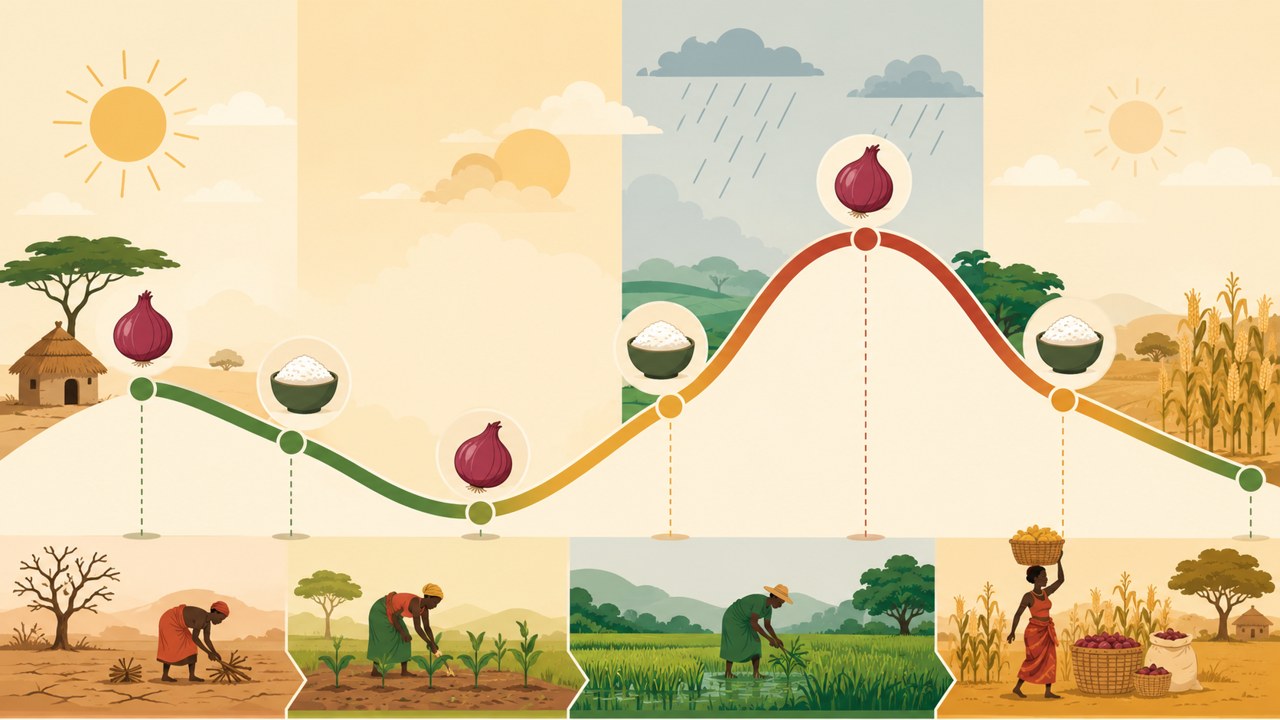
It’s the most volatile chain. At harvest (often February to April depending on the area), supply is abundant and prices drop; in the lean season (around November-December), scarcity sends them soaring. A few bulb onion readings (price per kg, FCFA):
| Market | High supply (Feb–Apr 2026) | Lean season (Nov–Dec 2025) |
|---|---|---|
| Bambili (North-West) | ≈ 300 | ≈ 700 |
| Bamenda Food Market | ≈ 500 | ≈ 1,000 |
| Mawa-Mozogo (Far North) | ≈ 100–150 | ≈ 200 |
Reading: on urban markets, the price can double between harvest and lean season. Selling everything at harvest often means selling at the worst time.
Marked regional gaps
Geography matters as much as season. In the Far North production basins (Mawa-Mozogo…), onion stays cheap. On urban and North-West markets (Bamenda…), driven by demand and transport, it’s worth two to three times more. Hence a simple rule: the price depends on when and where.
Rice: steadier, but worth watching
Rice is less volatile than onion: the imported share and the ability to store smooth variations across the year. Gaps mostly play out between local and imported rice and between regions. The logic stays the same: follow the trend rather than react to a one-off price.
What it means in practice
- Producers: avoid selling everything at harvest; store and stagger sales towards the lean season when possible.
- Traders: arbitrage between markets (buy in production zones, sell in demand zones) while covering transport.
- Processors: buy at peak supply, when raw material is at its lowest.
How to use these trends
Track prices on SIMRO’s Prices tab and learn to read them with our guide “reading SIMRO prices to sell at the right time“, plus our advice on how to stop selling blind.
Frequently asked questions
When is onion cheapest?
At peak harvest (often February-April), when supply is abundant. Prices then climb until the lean season (November-December).
Why is onion pricier in Bamenda than in the Far North?
Because the main production basins are in the North; towards urban markets, transport and demand push the price up.
Does rice follow the same seasonality?
Less strongly: the imported share and storage smooth variations. Watching trends is still useful.
From trend to sale
Understanding cycles is good; profiting from them is better. Jangolo connects you to buyers when the price works in your favour.
Partager :

Discover more from Jangolo Blog
Subscribe to get the latest posts sent to your email.