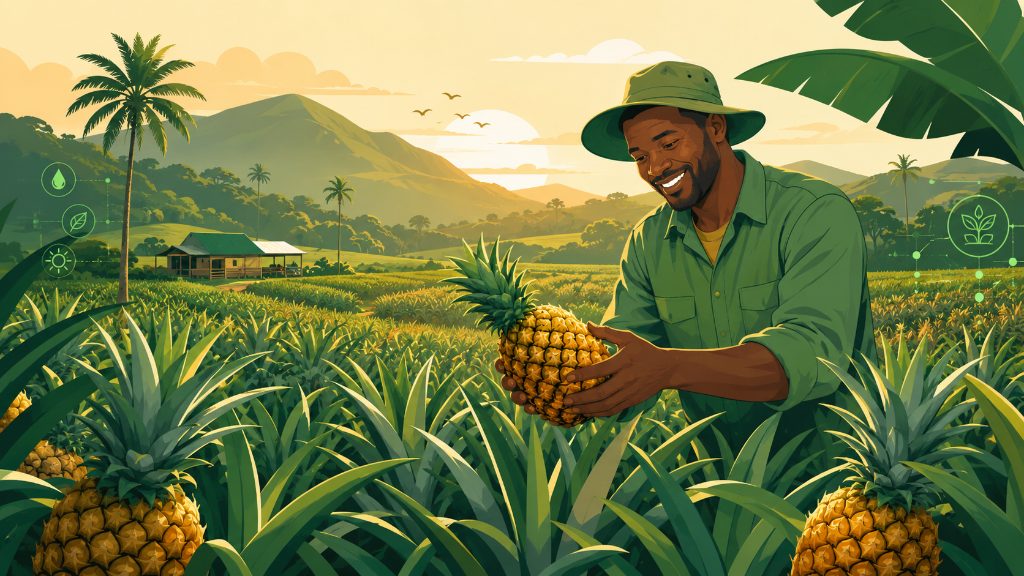
Growing pineapple: how to succeed with your plantation (complete guide)
Pineapple farming is a profitable activity if you know how to go about it — all the more so as the plant suffers from few diseases. A well-maintained pineapple plantation can be an excellent source of income. This guide shows you how to succeed, from soil preparation to harvest.
Pineapple is one of the most popular fruits, alongside mango. It is known for its rich, sweet taste: spiny and rough outside, soft and delicious inside. Native to the Caribbean, Central and South America, this highly nutritious fruit is eaten worldwide.
About the plant
The pineapple, botanically Ananas comosus, is a herbaceous plant growing up to 1.5 m tall. The stem is stocky, with thick, waxy leaves. At maturity, the plant produces up to 200 flowers that then fuse to form the spiny fruit.
Ideal conditions for growing pineapple
Coastal regions are the most suitable, as pineapple needs abundant rain and a humid climate.
Climate
A humid climate with abundant rainfall is ideal. The optimal temperature is between 22 and 32 °C: leaves grow best at 32 °C, roots at 29 °C. Pineapple does not grow below 20 °C or above 36 °C, and ideally needs a gap of about 4 °C between day and night temperatures — a night that is too warm is undesirable. Optimal rainfall is between 100 and 150 cm.
Planting season
Ideally, pineapples are planted 12 to 15 months before flowering. Timing depends on the onset and intensity of the rainy season. Avoid planting during heavy rains.
Soil
Pineapple can grow in almost any soil type, but sandy loam is best. The fundamental requirement is well-drained soil: it can even grow in heavy clay provided drainage is good. Water-retaining soils should be avoided. Alluvial and lateritic soils are also suitable.
Water and irrigation
As pineapple is generally grown in well-watered coastal areas, irrigation is not essential. In commercial production, however, supplementary irrigation helps produce good-sized fruit, allows off-season planting and ensures year-round production — common practice for export-quality pineapple. In hot, low-rainfall areas, irrigate once every two weeks.
Planting material
Pineapple is propagated from three organs: the crown (top of the fruit), slips and suckers. Planted at 5–6 months old, suckers and slips flower after 12 months, while crowns flower only after 19–20 months — which is why commercial farming favours uniform-sized suckers and slips. Various tissue-culture varieties are available for commercial production.
Land preparation
Pineapple is grown in trenches. The soil is well ploughed and worked: clods, rocks, stones and crop debris are removed, then the soil is levelled. Trenches are then dug 15 to 30 cm deep and 90 cm wide.
Planting
Slips and suckers aged 5–6 months are planted in the prepared trenches. Ensure uniform planting material for even flowering and harvest.
Maintenance operations
Because pineapple grows on loose soil with shallow roots, several maintenance operations are essential.
Earthing up
Shallow roots expose plants to lodging. If plants lodge during fruit development, the fruit develops irregularly. Earthing up — drawing soil from the ridges into the trench — gives the plants good anchorage.
Weeding
As hand weeding is laborious, chemical weeding is often used in commercial farming: a pre-emergence spray combining 0.6 kg of diuron and 0.8 kg of bromacil, repeated at half dose five months after the first application. Follow local herbicide regulations.
Mulching
Essential in rain-fed cultivation, mulching conserves moisture and limits weeds. Black polyethylene film is the simplest solution; a mulch of leaves and straw spread between the plants is the natural alternative.
Removing crowns, slips and suckers
Slips and suckers develop as the inflorescence and fruit emerge. Keep only one or two per plant: too many slips delay fruit maturity, so remove them once they reach the size needed for planting material. For an early harvest, remove them as soon as they appear.
Ratoon cropping
A pineapple plantation can be kept for up to three successive harvests. For the next cycle, keep the suckers from the original plant; earth up and fertilise properly to anchor the ratoon well.
Flower induction (forcing) and handling risky products
In the Moungo and other production basins, few growers wait for natural flowering: they use forcing (flower-induction treatment) to group flowering and plan the harvest. The most-used products are calcium carbide (which releases the acetylene that triggers flowering) and ethephon, sometimes combined with caustic potash (potassium hydroxide). They are effective, but dangerous if handled without precautions.
Protect yourself: your health depends on it. Caustic potash and calcium carbide are not harmless. On contact with skin or eyes, potash causes severe chemical burns — up to blindness — and its vapours attack the airways. Carbide releases a flammable gas and, in industrial grade, can release toxic impurities. Repeated, poorly protected exposure — handling the product bare-handed, breathing it without a mask, mixing it in open containers — endangers health over the long term. This is not inevitable: simple steps make the difference.
- Never touch these products bare-handed: rubber gloves, protective goggles and a mask are essential.
- Work in the open air, with your back to the wind, never in a closed room.
- Use dedicated plastic containers (never metal with carbide); never reuse them for drinking water or food.
- Keep products and containers out of children’s reach, away from heat and food.
- In case of contact, rinse abundantly with clean water for several minutes and go to a health centre.
Prefer the safest methods. Approved ethephon, used at the right dose and with protective equipment, is more manageable than artisanal carbide. “Organic” techniques are also emerging, such as ethylene-enriched activated-carbon induction (TIFBio), tested with good results. And before you start, get support from an agricultural adviser.
This topic goes beyond pineapple: to understand the risks of these products for producers and consumers alike, read our reference guide — Agricultural chemicals: health dangers and good practices.
Diseases and plant protection
Unlike many other crops, pineapple is little affected by diseases, which remain sporadic. Mealybugs and stem rot are the most likely. Dipping suckers in Bordeaux mixture before planting and ensuring good drainage is generally enough to prevent stem rot and other fungal diseases.
Fruit anomalies
This is the great challenge of pineapple farming: the fruit must have a perfect oblong shape and the right flavour, or it loses its market value. Here are the most common anomalies.
Multiple crowns
Some fruits bear more than one crown (up to 25 in extreme cases). The top of the fruit becomes wide and flat, the flesh corky and the taste bland — making the fruit unfit for canning.
Fasciation
Fasciation makes pineapples unfit for consumption. Very high soil fertility and very favourable climatic conditions stimulate excessive vegetative growth that causes it. These plants flower later; in extreme cases the fruit is flat, twisted, with countless crowns.
Collar of slips
A large number of slips at the base of the fruit produces a tiny, conical fruit. High nitrogen fertilisation, heavy rain and relatively low temperature are the combined causes.
Harvest
It generally takes 2 to 2.5 years for a pineapple plantation to reach harvest: flowering 12–15 months after planting, fruiting after 15–18 months, and fruit maturity about 5 months after the inflorescence. Fruit for canning is harvested as soon as a slight colour change appears at the base; table fruit waits for a fine golden-yellow colour. The yellowing of the fruit’s “eyes” indicates maturity.
Harvested fruit is graded by size, colour and weight before storage. Yield varies with cultural practices and spacing: count on 20 to 30 tonnes per hectare.
Storage
After harvest, fruit with the crown keeps for up to 15 days without damage. For transport, refrigeration slows ripening: 10–13 °C for a maximum of 20 days, with optimal storage at 7.2 °C and 80–90% relative humidity.
In conclusion
Pineapple farming is a commercially viable agricultural activity: it offers a good yield with minimal care. A thriving plantation rests above all on good management and rigorous cultural techniques.
Do you grow or want to sell pineapple? Create your Jangolo account to reach buyers across Cameroon. And to sell your pineapple well — markets, direct sales, cooperatives, contracts, export and digital tools — see our guide on every channel for selling your farm produce.
Partager :

Discover more from Jangolo Blog
Subscribe to get the latest posts sent to your email.