How to grow ginger: a complete cultivation guide
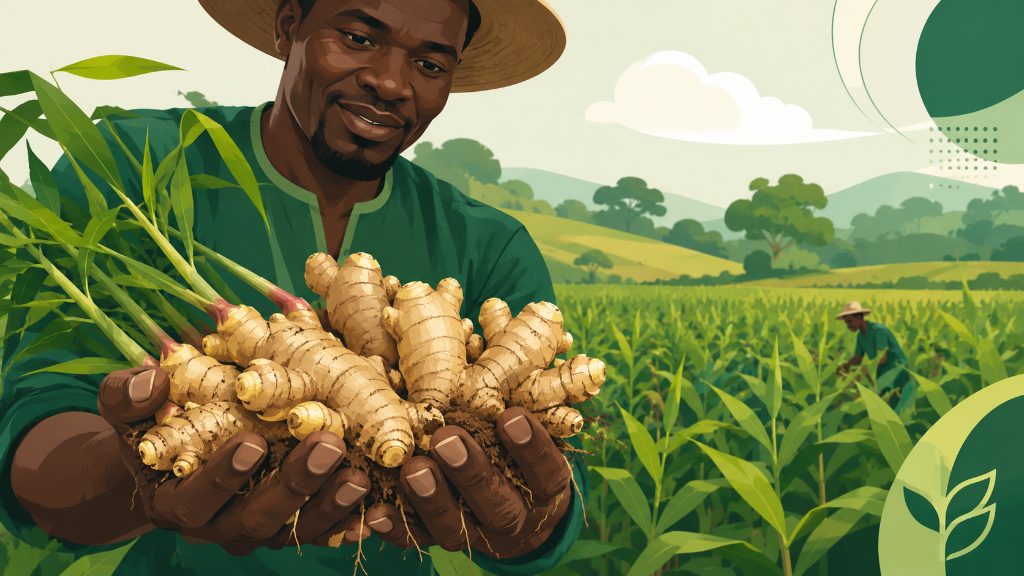
Ginger, Zingiber officinale, is a herbaceous plant native to Asia. It is grown for its rhizomes, which — once dried — are used as a spice in many dishes for their delicate aroma and more or less fiery flavour. Commonly called “Djinja” in Cameroon, it is eaten fresh, dried or as a powder, and is also used by bakers and confectioners and for preserving meat. Here is a complete technical guide to succeeding at ginger cultivation in Cameroon and elsewhere.
1. Conditions favourable to ginger
Ginger loves a tropical climate where the temperature is high for at least part of the year, with abundant rain, sun and little wind. The crop needs roughly 1,100 litres of water/m² — about 11 million litres/ha — to produce good ginger. Average annual rainfall should exceed 2,000 mm; supplementary irrigation becomes necessary below 1,000 mm. It thrives at altitudes between 500 and 1,500 m.
To prosper, ginger requires very light, rich, acidic, stone-free soils so the rhizome can develop properly. The ideal soil is humus-rich, easy to work and well drained, as ginger dislikes excess moisture. Light loamy or sandy-clay soils suit it very well.
2. Cultivation techniques
2.1. Propagation
Propagation is by dividing the rhizomes just before growth resumes. Divide by hand into pieces each bearing at least one bud; the final yield is proportional to the size of the starting rhizome. Let the cut dry well before planting flat at the surface; the substrate should not cover more than half the thickness of the rhizome.
Ginger grows quickly. Since you must wait 2 to 3 months to plant rhizome pieces from a plot, plants can be left in the soil until planting, covered with regularly renewed mulch to prevent drying out.
2.2. Soil preparation
Soil preparation is done in February–March. It is very important and must be done carefully, since the useful part of the plant is underground:
- Clear the site, systematically removing any roots that could hinder rhizome development.
- Pile up and burn locally the residues that do not rot quickly.
- Plough flat or form ridges or beds at least 30 cm high. Crumble the soil sufficiently.
- Enrich the soil with plenty of compost or poultry droppings — about 40 to 60 tonnes/ha, i.e. 400 to 600 bags of 100 kg.
2.3. Planting
Ginger is planted between mid-March and mid-April. Use fresh rhizome pieces, each bearing 3 to 5 eyes, cut with a sharp knife to about 2.5 cm long. Seed quantity ranges from 900 to 1,350 kg/ha.
Submerge a third of the ginger in a glass of water and leave it until the roots are about thumb-sized. Rhizome pieces are planted 10 to 15 cm deep. Young shoots appear around the 10th to 15th day after planting; emergence is complete by the 3rd week.
Planting density
For a density of 95,000 to 100,000 plants per hectare, use the following spacings:
- Ridge width: 0.90 m
- Distance between ridges: 25 to 30 cm
- Spacing between plants: 15 × 25 cm; 25 × 30 cm; 30 × 30 cm.
2.4. Fertilisation
These are exhausting plants. Put one or two handfuls of manure, or a mix of manure and ash, in each hole — a base dressing of 10 to 12 tonnes plus more than 2 tonnes of ash per hectare.
If the soil is enriched before planting, no fertiliser is needed as the ginger grows; all it then requires is an adequate water supply and sunlight. Otherwise, apply 11-11-22+5.5 or another potash-rich fertiliser at 20–25 kg/1,000 m², in a small furrow dug parallel to the planting rows, then close it up.
2.5. Maintenance
Once planted, the beds are covered with a thick layer of quickly-rotting leaves, acting as green manure but mainly protecting the topsoil from the sun’s heat. When the young plants are well developed, clean the beds with careful weeding, then mulch again as before. This mulching is repeated at the end of the 3rd month. Mulching has been found to have a lasting effect, benefiting not only the ginger but also the crops that follow.
Stop watering as soon as the leaves are half yellow, resuming only gradually with the appearance of the first new shoots.
2.6. Diseases and pests
Diseases
On the leaves, several fungi produce spots.
Pests
Ginger’s enemies are common — notably red rot and dry/black rot on the rhizomes, and species causing root decay and damping-off. Attacks on ginger are generally minor, however, and usually require no special treatment.
2.7. Harvest
The sign that ginger is ready is the yellowing and wilting of the leafy stems. Ginger destined for canning is harvested before maturity, between late March and early April, otherwise the rhizomes become too fibrous and pungent.
From April to June, ginger is harvested for drying and oil pressing. In July/August, fresh ginger is harvested and dried. In early September, the last shoots are harvested and serve as seed for the new crop; seed can remain in the soil in the field. Harvest carefully with a spade or fork. The leaves are discarded as unfit for consumption.
Avoid wounding the rhizomes. Clean them immediately, removing roots and adhering soil without delay. Wash the rhizomes and dry them in the sun, where they take on their characteristic light-yellow colour.
2.8. Ginger yield
Yield varies by country, from 20 to 30 t/ha. Fresh ginger gives only 20 to 30% dried ginger.
Sell and go further
Do you grow or trade ginger? Create your Jangolo account to reach buyers across Cameroon. To understand how a crop creates value from field to market, read our analysis of Cameroon’s cocoa value chain, and see every channel for selling your farm produce.
Partager :

Discover more from Jangolo Blog
Subscribe to get the latest posts sent to your email.