Water Fufu & Eru: The Soul of South-West Cameroon on a Plate
Available in French: Water Fufu & Eru : l’âme du Sud-Ouest camerounais dans une assiette
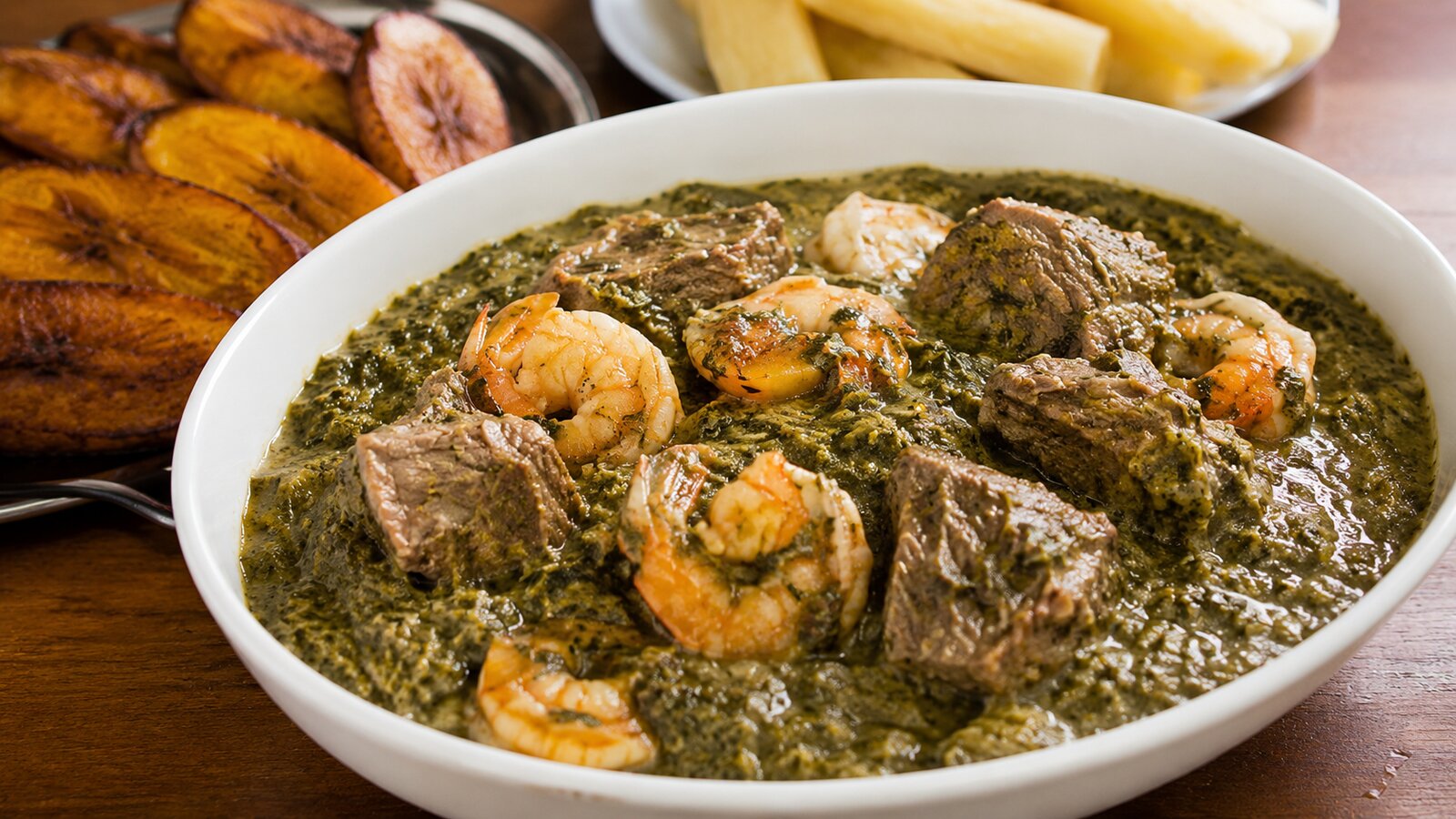
Walk through the markets of Buea, Limbe or Kumba and you’ll spot the okok from a distance. Mountains of dark green leaves, stacked in tight bundles, sold fresh in the morning or sun-dried by the women who pick them. It’s the ingredient without which Eru simply cannot exist. And when a South-West Cameroonian says “water fufu and eru,” they’re not naming a dish — they’re naming a piece of who they are.
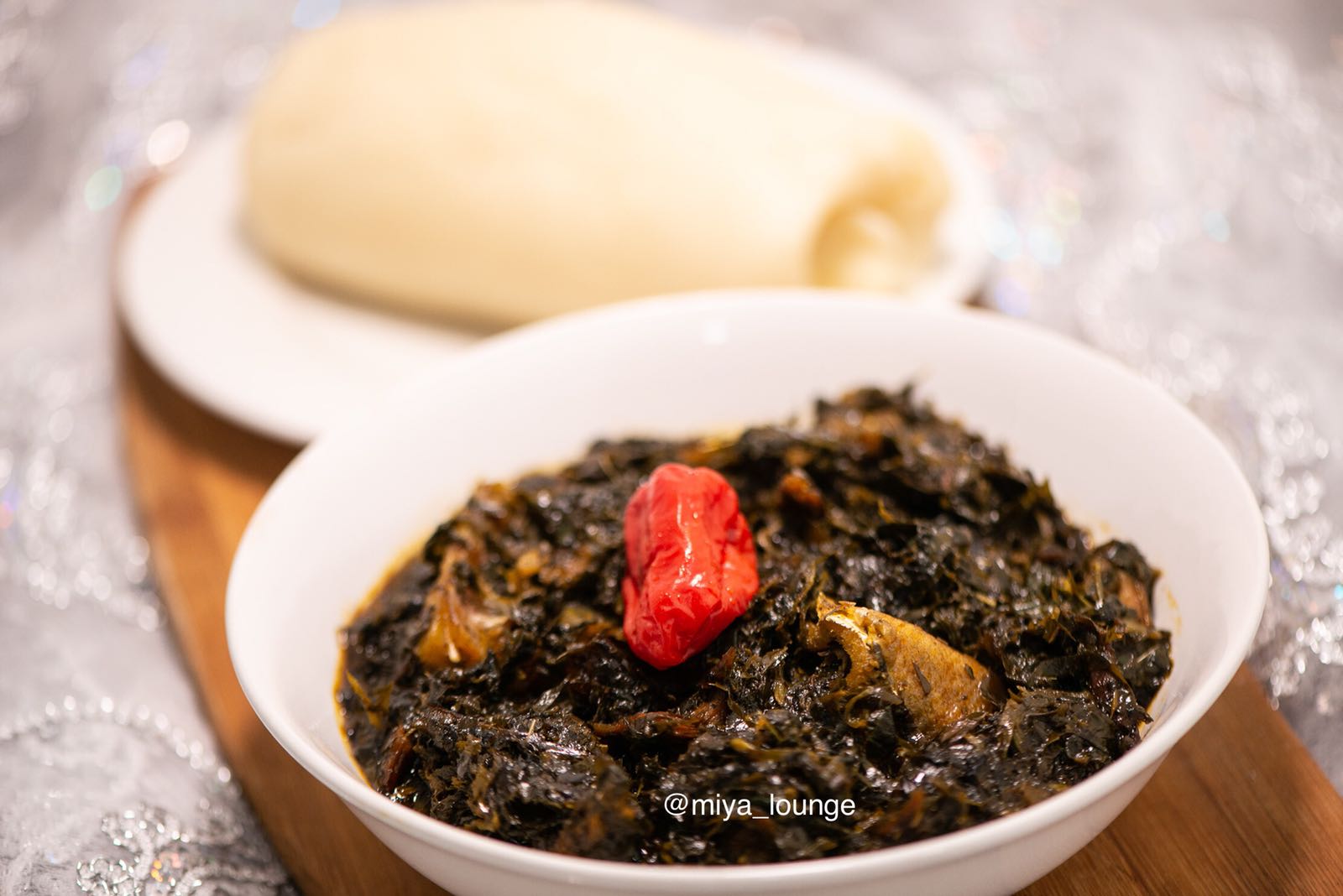
Water Fufu & Eru is one of the most beloved dishes in Cameroonian cuisine. Originating in the Anglophone South-West region, carried by the Bayang, Bakossi, Bakweri and Banyang communities, it has long since conquered every table in Cameroon — Francophone households included. It is fundamentally the meeting of two elements: a dense green sauce of okok and waterleaf, and a ball of fermented cassava (the water fufu) used to scoop it up.
Eru at a glance
| Origin | South-West Cameroon (Bayang / Bakossi cuisine) |
| Type | Slow-cooked leafy sauce, served with water fufu |
| Total time | About 45 minutes |
| Serves | 8 people |
| Difficulty | Accessible (progressive simmering technique) |
| Indicative cost | Moderate, depending on meat and crayfish prices |
The story: a dish that tells the story of Anglophone Cameroon
Eru takes its name from its central ingredient: okok (Gnetum africanum), a wild forest vine native to Central Africa. For the communities of South-West Cameroon — Buea, Mamfe, Kumba, Mundemba — it is the Sunday dish par excellence: the one cooked when the family gathers, when an honored guest arrives, or when a traditional ceremony calls for something more than ordinary food.
Its inseparable partner is water fufu: a soft, pasty ball of fermented cassava, steamed and served warm. Slightly tangy, white, and dense, the water fufu is what makes the experience complete. The eating ritual is its own thing: you pinch a piece of fufu between your fingers, hollow it slightly, dip it into the eru sauce, and bring it to your mouth in a single fluid motion. Eru is a dish you eat with your eyes, your fingers and your palate together.
What sets Eru apart from other African green sauces (okra, ndolé, leafy stews) is the specific pairing of okok and waterleaf. Okok brings texture and a deep vegetal taste; waterleaf brings moisture and a subtle sweetness. The balance between the two is what defines whether the dish is a success — it’s all about proportion and timing.
The signature ingredients of Eru
Eru rests on a handful of distinctly Cameroonian ingredients worth knowing well — especially if you’re cooking it abroad in the diaspora.
Okok (Gnetum africanum)
The wild vine of Cameroon’s rainforests, harvested mainly in the South-West and Littoral regions. Sold fresh in tight bundles or dried in small bags, it’s recognizable by its small glossy leaves and chewy, vegetal taste. For a successful Eru, choose fresh okok over dried whenever possible — dried is more convenient to store but fresh delivers an incomparably better color and flavor. In the diaspora, look for it in African grocery stores under names like “eru leaves,” “afang,” or simply “okok.”
Waterleaf
Literally “water leaf,” this is a leafy plant with small tender, juicy leaves. It provides the moisture of the sauce — in traditional cooking, almost no water is added; the waterleaf releases its juice as it cooks. Choose bunches that are bright green, with no wilted or yellow leaves. Outside Cameroon, spinach or pak choi can substitute, but the texture will differ.
Cow skin (kanda) and crayfish
Two ingredients that make all the difference. Cow skin (called kanda in Cameroon, ponmo in Nigeria) brings collagen-rich texture and a luxurious mouthfeel after slow simmering. Cameroonian crayfish (dried or fresh depending on availability) bring the marine umami that balances out the dish’s rich vegetal base. You can skip either one but the Eru will lose depth.
The full list of 8 ingredients with precise quantities is available on the official Jangolo recipe page, with a total cost estimate calculated from real-time market prices.
When to serve Water Fufu & Eru
Eru is traditionally a gathering dish, not an everyday meal. Here’s when it makes the most sense:
- Sunday family lunch — the iconic Eru moment in South-West Cameroon
- Traditional ceremonies — weddings, births, funerals in Bayang, Bakossi, Bakweri and Banyang communities
- Welcoming an important guest — in Anglophone tradition, serving Eru to someone says “you are home”
- Coming home — the diaspora’s reunion dish, served when a family member returns to the village
Serve it hot, in a deep bowl, with a ball of water fufu placed alongside — never mixed in advance.
3 common mistakes to avoid
1. Overcooking the leaves
The number-one mistake. Okok and waterleaf are not treated like European spinach: okok needs enough cooking to become tender (otherwise it’s stringy), but waterleaf must be added near the end to keep its freshness. An Eru where both leaves have simmered together for 30 minutes ends up grey-brown and lifeless.
2. Skimping on palm oil
Red palm oil is not just a cooking fat in Eru — it’s the aromatic base of the dish. It delivers the color, the signature scent, the richness. Cooking Eru with a neutral oil (sunflower, corn) gives you a pale, flat dish. And you need enough of it: Eru is not a diet meal, and trying to make it one strips its identity.
3. Serving it with the wrong starch
Eru is traditionally served with water fufu (steamed fermented cassava), not with rice, fries, or even corn fufu. The slight tang of water fufu plays with the richness of the sauce. If water fufu is unavailable, garri (cassava couscous) or pounded yam can work — but rice strips 80% of the experience. In the diaspora, mashed plantain or fufu flour reconstituted with hot water is the most accessible substitute.
A grandmother’s tip: add the crayfish 5 minutes before the end so they flavor the sauce without drying out.
The full recipe, step by step
Ready to cook? The detailed list of 8 ingredients, the quantities for 8 servings, the step-by-step cooking instructions and the total cost estimate are on the official Jangolo recipe page:
👉 See the full Eru recipe on jangolo.cm →
More Cameroonian recipes to discover
- The complete library of 141 African recipes on Jangolo
- Kondrè with Beef, another iconic Cameroonian dish
- Roasted chicken gizzards, traditionally reserved for the head of the family
Cooking Eru your own way? Join the Jangolo community and share your recipe with other Cameroonian cuisine lovers →
L’okok (eru), une filière à part entière
Derrière le plat, l’okok — de son nom scientifique Gnetum — est une plante forestière non ligneuse riche en protéines, dont les feuilles sont récoltées puis écoulées sur les marchés par les bayam-sellam. Sa consommation a fortement progressé ces dernières années, portée par sa popularité bien au-delà du Sud-Ouest et par une exportation croissante, au point de structurer une véritable économie de marché. Cette demande soutenue a stimulé les efforts de domestication de la plante, longtemps simplement cueillie à l’état sauvage : l’objectif est d’en sécuriser l’approvisionnement, d’améliorer les revenus des cueilleurs et de préserver la ressource forestière.
Partager :

Discover more from Jangolo Blog
Subscribe to get the latest posts sent to your email.