The PIF method: multiply your plantain suckers fast (CARBAP technique)
The first hurdle for any plantain plantation is planting material: suckers are expensive, scarce and often carry diseases (weevils, nematodes). The PIF method (Plants from Stem Fragments — “Plants Issus de Fragments de tige”) solves this: developed in the early 1990s by researcher Moïse Kwa at CARBAP in Njombé, it lets you produce 10 to 20 healthy plants in 3-4 months from a single sucker, with local materials and a tiny cost. On 200 m² of propagators, you can produce 10,000 to 20,000 plants a year — enough to plant or… to sell.
The stakes are huge: according to CARBAP, Cameroon needs around 20 million plantain plants per year. Demand far outstrips supply — hence the interest, agronomic and economic, of mastering PIF.
The principle
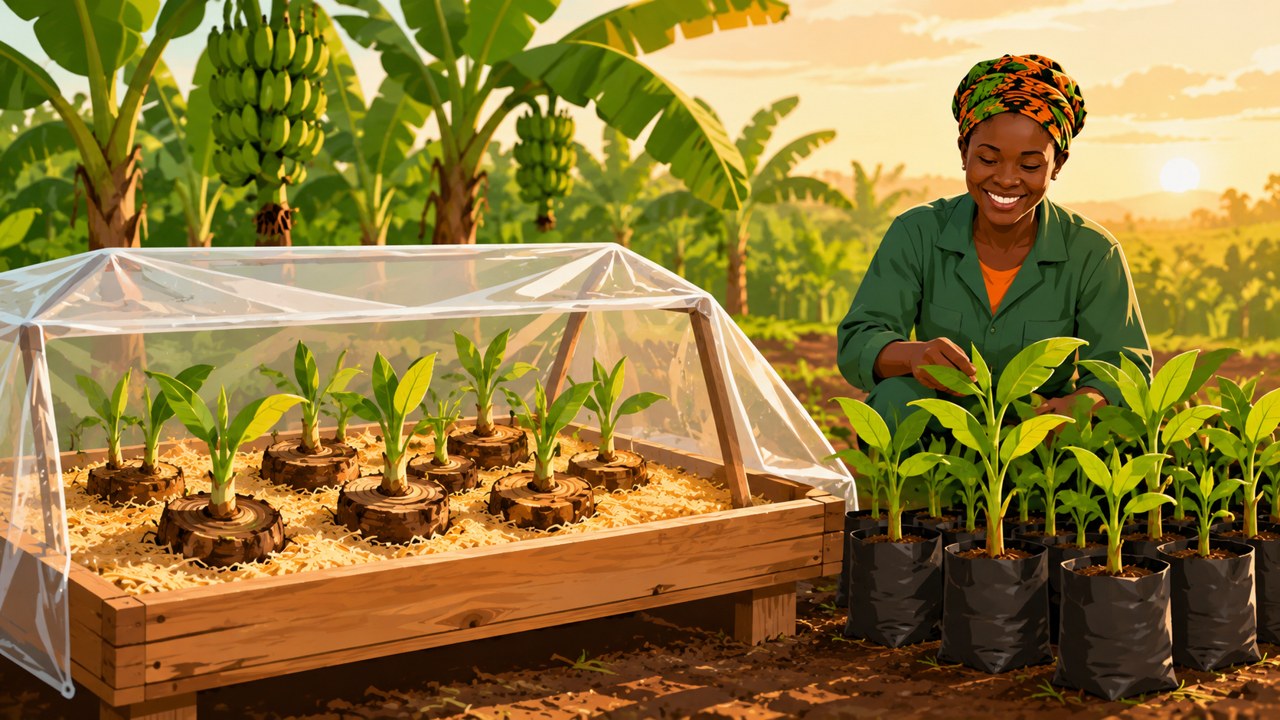
You wake up the dormant buds of the corm (the “stump”). Stripped of its leaves and roots, the stem fragment is incised to break apical dominance, then placed in a warm, humid propagator. Each activated bud produces a plantlet, which is weaned and then raised in a nursery before planting. Key advantage: the plantlets produced are free of weevils and nematodes and hardy, because obtained under natural conditions.
PIF, natural suckers or tissue-culture plants? The comparison
| Criterion | Natural suckers | Tissue-culture plants (lab) | PIF method |
|---|---|---|---|
| Plants per stump / cycle | 4 to 5 per year | very high | 10 to 30 |
| Time | 6 months and more | several months (lab) | 3 to 4 months |
| Cost | variable, often high | high, hardly accessible | very low (local materials) |
| Health status | risky (parasites) | healthy | healthy |
| Skill required | low | high (laboratory) | moderate, accessible |
PIF thus combines the best of both worlds: the sanitary quality of tissue-culture plants, without the cost or the laboratory.
The method, step by step
- Choose the suckers: healthy sword suckers of in-demand varieties (French, Big Ebanga…).
- Trim the corm: remove roots, soil and sheaths down to the white corm, without injuring the buds. Disinfect (diluted bleach or boiling water for a few seconds).
- Incise: cut the stem 2 cm above the corm and make cross-shaped incisions to break apical dominance.
- Set in the propagator: a shaded bin filled with moist white sawdust (about a 10 cm layer, fragments buried two-thirds then covered with 3-5 cm), under a plastic cover to keep heat and humidity. A typical propagator is about 3.8 m × 1.5 m × 0.5 m.
- Wean (4-8 weeks): take the plantlets with 4-5 leaves and their roots, transplant them into nursery bags under shade.
- Harden off and plant (2-3 months): gradually reduce shading; the plant is ready at 30-40 cm.
The mistakes that ruin a propagator
- Red or mouldy sawdust: use fresh white sawdust, renewed between cycles.
- Excess water: moist doesn’t mean soaked — rot is the number one enemy.
- Diseased suckers at the start: PIF cleans up a lot, but works no miracles on a rotten corm.
- Abrupt weaning: without gradual hardening, losses at planting explode.
A profitable business in itself: becoming a nurseryman
Many Cameroonian agripreneurs turn PIF into a genuine nursery business. The logic is compelling: national demand of ~20 million plants/year, very low production cost (sawdust, tarp, bags), and healthy plants that sell well to growers. A 200 m² unit can output 10,000 to 20,000 plants/year — a regular income, alongside or even before your own plantation.
How Jangolo helps you
Mastering PIF is good; turning it into a profitable business is better. Jangolo helps you at every step:
- Train and find support: locate trainers, nurserymen and agricultural experts in the Jangolo directory of companies and service providers.
- Source and connect with producers: find healthy suckers and other plantain producers on the marketplace to secure your starting material.
- Sell your plants and your produce: move your PIF plants and bunches through Jangolo Trade, which connects you directly to buyers — national demand exceeds 20 million plants per year.
- Finance your unit: propagators, shade nets and bags can be financed; reach more buyers and channels via every channel for selling your farm produce.
Frequently asked questions
How many plants per sucker with PIF?
10 to 20 plants per sucker with careful management (up to ~30 in the best units) — versus 4 to 5 natural suckers per stump per year.
How long from propagator to planting?
3 to 4 months: 4-8 weeks in the propagator then 2-3 months in the nursery. That’s twice as fast as the natural route.
PIF or tissue-culture plants: which to choose?
Tissue-culture plants (lab) offer huge volumes but are expensive and hardly accessible. PIF gives equally healthy plants, at low cost and without a laboratory — ideal for a local producer or nurseryman.
Do you need expensive equipment?
No: a bin or boards, white sawdust, a plastic tarp, nursery bags — that’s the whole advantage of PIF.
Which varieties to multiply?
Favour the varieties growers and markets want (French, Big Ebanga, Batard…), to sell your plants more easily.
Going further
Ready to sell your PIF plants or your produce? Sell with Jangolo Trade.
Partager :

Discover more from Jangolo Blog
Subscribe to get the latest posts sent to your email.