Why African Consumers Will Shop Differently in the Years Ahead
Disponible en français : Pourquoi les consommateurs africains vont acheter différemment dans les prochaines années
Marina, 26, books a haircut at a neighbourhood salon. Before confirming, she types the salon name into her phone and reads the Google reviews. She checks the Instagram photos, verifies posted prices, compares with another salon 600 metres from home. Total: 90 seconds of verification before a 5,000 FCFA service. Her mother didn’t have that reflex at her age. Her daughter will have it even more so in ten years.
What’s true for the hairdresser, the hotel, the moto-taxi or the restaurant is starting to be true for food shopping. And that extension is not a detail — it’s a structural transformation of African food commerce. The African consumer of 2030 will not look like the consumer of 2020. This article looks at what’s changing, why, and what it imposes on the commerce of tomorrow.
Four forces durably reshaping African consumption
This shift isn’t a trend. It rests on four deep tendencies that reinforce each other, and that are today irreversible at continental scale.
1. Smartphone penetration is now generational
In Cameroon, more than 60% of urban adults access the internet via mobile. Among 18-35-year-olds, the figure approaches 90%. This generation didn’t learn to use the phone — it grew up with it. The smartphone isn’t a special tool you pull out for shopping: it’s the default interface for every daily choice. And this generation is the one founding households and managing food budgets over the next decade.
2. Urbanisation accelerates and reshapes habits
Cameroon is already over 57% urban, and growth continues. Yaoundé, Douala, Bafoussam, Garoua, Bamenda — these cities concentrate a consumer who no longer has hours to spend bargaining at the market, who must constantly arbitrate between proximity, price and quality, and who develops a transparency demand unknown in rural areas. Urbanisation mechanically produces more information-driven consumers.
3. Inflation has recoded the relationship to spending
Successive food price shocks since 2020 — pandemic, international tensions, freight cost surges, eroded purchasing power — have changed something deep: Cameroonians who used to buy without checking have learned to check. That budgeting discipline, once acquired, doesn’t disappear when prices ease. It anchors. And it feeds a structural demand for comparison tools.
4. The connected diaspora broadcasts global reflexes
Cameroonians in the diaspora — Paris, Brussels, London, Montreal, New York — have long lived in ecosystems where comparing prices before any purchase is the norm. Via WhatsApp, family networks and trips home, these reflexes transfer to family who stayed in Cameroon. When a cousin in Yaoundé sees his Montreal brother check an app to buy a phone, he internalises the behaviour. The country doesn’t reinvent its habits in a vacuum.
The new African consumer in four traits
At the intersection of these four forces, a fast-spreading consumer profile is emerging, particularly among urban 20-40-year-olds. Four traits define this consumer.
Digital-first
The phone is consulted before, during and after any significant purchase. Not out of perfectionism, out of reflex. Even a bottle of cooking oil can prompt a quick check. What feels surprising today will be standard tomorrow.
Opportunistic
This consumer knows how to wait. If a product is expensive this week, he watches for a promotion next week. If a shop runs high prices, he switches. Automatic loyalty — « I go there because my parents went there » — fades in favour of opportunity-based loyalty.
Connected
Before buying, she consults her WhatsApp groups, reads reviews, asks for advice. Word of mouth hasn’t disappeared — it has digitalised and accelerated. A bad shop experience spreads to hundreds of people within 24 hours.
Value-driven
Brand for brand’s sake no longer cuts it. This consumer hunts for real value for money, and knows how to spot a genuine deal versus a fake promotion. Open to local when local is competitive. Open to quality when it is demonstrated. Refuses to pay an unjustified « image premium ».
What this changes for food commerce
For food commerce actors — shops, supermarkets, agroindustries, processors — these shifts aren’t neutral. They impose fundamental changes in how to think about customer acquisition.
- Automatic loyalty fades. Counting on habit no longer works. Every week the buyer is solicited, compares, may switch elsewhere. Keeping a customer means continuing to prove value.
- Invisibility becomes the biggest risk. A shop without even a minimal digital presence progressively loses visibility among young urban households. Not out of hostility — because it simply doesn’t exist in their decision perimeter.
- Local becomes competitive if it is visible. The value-driven consumer has no bias against local — quite the opposite. But she needs to see it, compare it, verify it really is cheaper or better. Visibility becomes the multiplier of local production.
- Attention windows shrink. The consumer decides in seconds. If the information isn’t clear, readable, comparable, she moves on. Sellers who don’t master transparency stay invisible even when they’re competitive.
Jangolo Promotions’ role: the discovery point
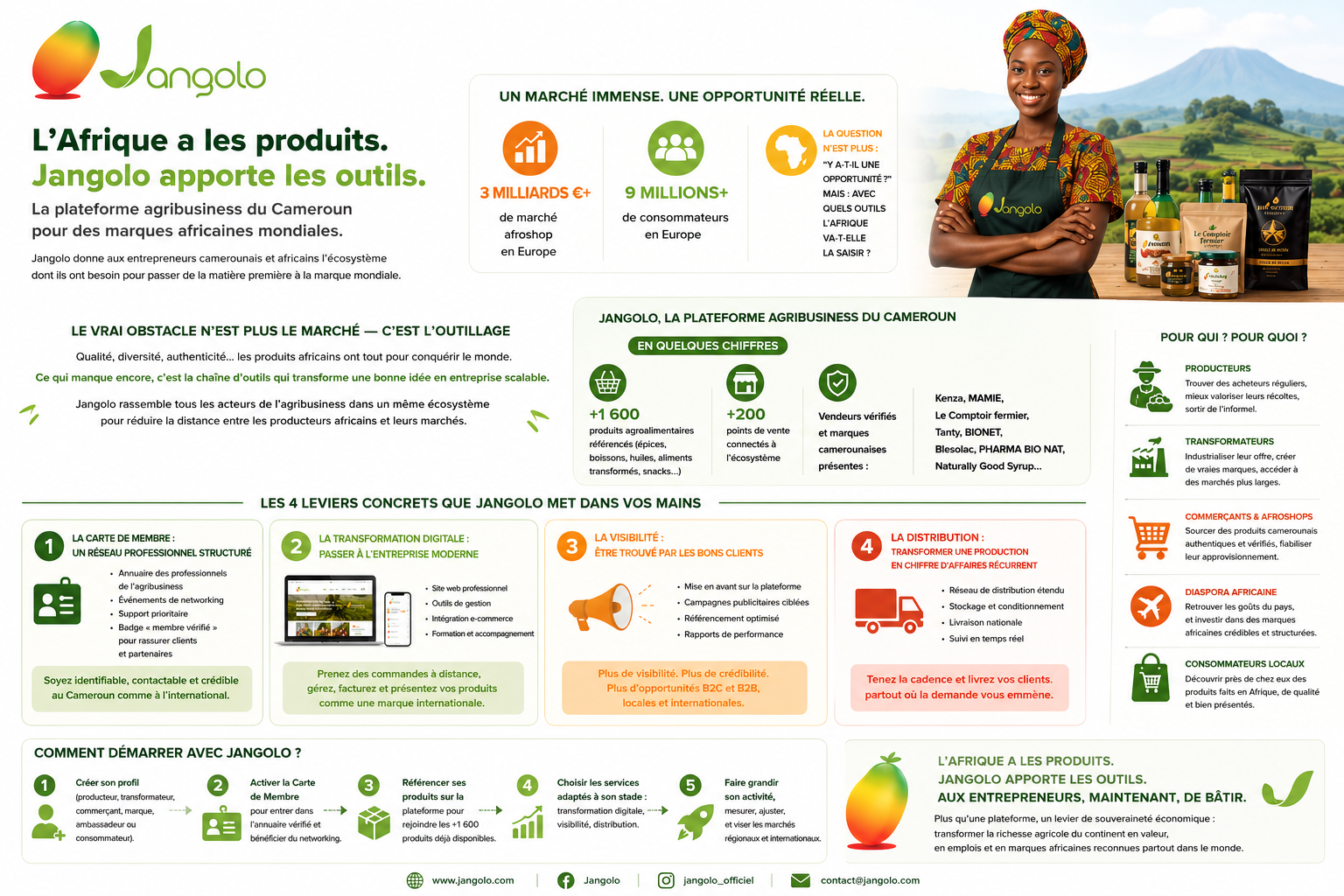
In this new landscape, Jangolo Promotions doesn’t create the behaviour — it accompanies a behaviour already entrenched in the African consumer and extends it to food. The platform positions itself on the same reflex as classifieds sites or restaurant comparison apps: becoming the discovery point for opportunities, specifically in food commerce.
The logic is simple:
- For the connected consumer — a single, reliable place, in her phone, aggregating food offers across a neighbourhood or city.
- For the seller wanting to stay relevant — a channel to make offers discoverable beyond the circle of regulars, and capture this new generation of consumers.
- For local producers — a door to an audience specifically seeking authentic, well-valued products.
What the next 2-3 years will cement
Several things will crystallise during this decade, and they will define African food commerce in 2030.
- Checking before grocery shopping will no longer be a savvy urban reflex — it will be the norm, even in semi-urban areas.
- Food brands will be judged on transparency: posted prices, composition, origin. Those that bet on opacity will lose.
- Neighbourhood commerce won’t disappear — but it will need a digital signature. Not an expensive website: just a presence on the platforms consumers consult.
- Cameroonian local products will have their chance — if and only if the visibility infrastructure makes room for them. This is one of the silent stakes of this decade.
The shift is already underway
Marina, the young woman from the opening, doesn’t see her behaviour as exceptional. To her, checking before buying is logical. Not checking would be strange. Multiply Marina by the millions of urban young Cameroonians — and by their cousins in Lagos, Abidjan, Dakar, Nairobi — and you get an African food market that is tipping, slowly but surely.
Sellers, shops, agroindustries that act on this shift now gain a durable advantage. Those who wait for « it to happen » risk an expensive catch-up game in 3 or 5 years. Jangolo Promotions is one of the pieces of infrastructure on which this shift rests — from both sides.
The best moment to step in, from either side, is now.
More in the series
- Article 1 — African Food Commerce Has a Visibility Problem
- Article 2 — Why Food Promotions Have Become Essential in Cameroon
- Article 3 — How to Find the Best Food Promotions Near You
- Article 5 — Why promotions are a strategic tool for agroindustries (coming)
Share this content:
Partager :

En savoir plus sur Jangolo Blog
Subscribe to get the latest posts sent to your email.