How Shops Attract More Customers Through Digital Promotions
Disponible en français : Comment les boutiques attirent plus de clients grâce aux promotions digitales
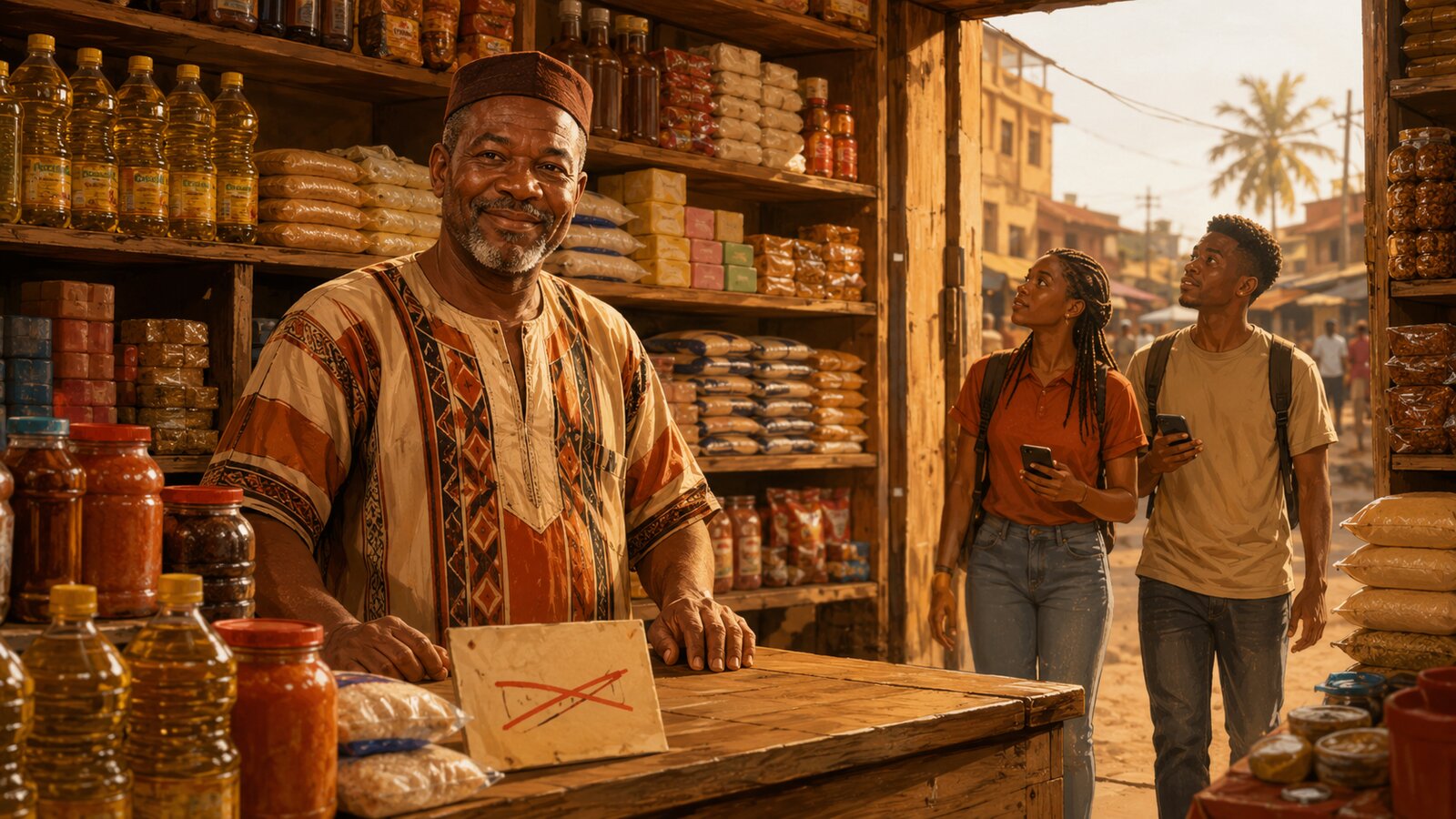
Mr Talla has run a neighbourhood shop in Bonamoussadi for 14 years. He knows his customers by their first names, knows their favourite rice brand, knows which day Mrs Atangana stops by for her cooking oil. But for two years, something has been bothering him: fewer people in the morning. Not a sudden drop — a slow decline. 90 customers a day four years ago, 65 today. The older ones keep coming. The younger ones, much less.
Asked why, Mr Talla has a partial intuition: « Young people go to the supermarket. » Not quite. Young people check before going anywhere. And if they’ve never heard of your shop, you don’t exist in their decision perimeter. It’s not that you’re less competitive. It’s that you’re invisible.
This article is for shopkeepers, small supermarket managers, neighbourhood retailers in Cameroon who feel this drift without always knowing how to respond. Good news: the answer isn’t to become a website. The answer is called footfall marketing, and digital promotions are its most effective lever.
Neighbourhood retail isn’t dying — the acquisition channel is changing
First, let’s say it clearly: neighbourhood retail in Cameroon stays strong and resilient. Cameroonians love their corner shops, the human contact, the transaction flexibility, the trust built with a familiar trader. The model isn’t dead — the acquisition channel has changed.
For 30 years, a shop recruited customers through three mechanisms: walking past, word of mouth, and family habit. That was enough as long as everyone lived, walked and moved within the same perimeter. But today:
- Young urbans move by motorbike taxi and rarely walk past your shop.
- Word of mouth has shifted to WhatsApp and Facebook, where you’re not present.
- Family habit no longer transmits automatically — the children of loyal customers don’t become your loyal customers.
The variable that disappears is spontaneous visibility. The variable that replaces it is chosen visibility — your shop appears when a consumer searches for an offer, because you’re there. That’s the whole point of footfall marketing.
Footfall marketing: bringing the customer in, physically, through digital
Footfall marketing is a simple idea: use a digital channel to bring people into your physical shop. You don’t sell online. You don’t deliver to homes. You signal online that there’s a good reason to visit you this week.
This is exactly the model the best global chains run today: Walmart, Carrefour, Auchan display weekly digital promotions — not to sell online, but to maximise in-store traffic. Digital amplifies the local instead of competing with it.
For a Cameroonian neighbourhood shop, the model is all the more relevant because it combines two strengths:
- Publishing effort is minimal. You post an offer in minutes — no website needed, no new logistics.
- Impact is measured immediately. The morning of the promotion, you count new faces walking through the door. No opaque digital metrics, just real footfall.
Why Facebook and WhatsApp aren’t enough
Many Cameroonian shops have already taken a digital step: Facebook page, WhatsApp statuses, sometimes an Instagram account. Better than nothing. But these channels have a structural limit few observers mention: they speak to your existing customers, not to your potential market.
A promotion posted on your Facebook page reaches people who follow the page. An offer sent in a WhatsApp status reaches contacts who saved your number. In both cases, the audience is the one that already knows you. You’re not recruiting new customers — you’re animating current ones.
That’s useful for retention. Not enough for growth. Footfall marketing requires a third layer: a channel where you’re discovered by consumers who didn’t know you before. That’s where acquisition happens.
How Jangolo Promotions plays that role for shops
Jangolo Promotions is designed exactly for this third layer — the channel where your shop becomes discoverable by consumers searching for food offers in your area.
Concretely, what the platform brings to a neighbourhood shop:
Geographic visibility
Every offer shows the city, neighbourhood, sometimes the street. A Bonapriso buyer looking for cooking oil on promotion can discover your shop even if they’ve never walked past it. Your visibility perimeter widens from a few streets around your shop to the whole city, with zero advertising spend.
In-buying-mode audience
On Facebook, people scroll out of habit. On Jangolo Promotions, they come looking for a good food deal. Buying intent is explicit. A promotion posted on the platform reaches people who have already decided to compare — you show up at the right moment in their purchase journey.
Zero entry cost
Posting a promotion on Jangolo Promotions is free. No advertising budget to negotiate, no campaign to schedule. A good offer, a few photos, a duration, and it’s live. It’s the lowest cost-per-customer acquisition channel available today for a Cameroonian neighbourhood retailer.
What kind of promotion works for a shop
Not all promotions are equal. Four formats stand out for neighbourhood retail — each activating a different mechanism.
1. The loss-leader promo on a star product
Pick a product everyone buys (oil, rice, sugar, soap) and offer it at -15 or -20% for a week. Even a modest discount on a high-rotation item generates disproportionate traffic. Once in the shop, the customer also buys other groceries at full price. That’s the loss-leader principle — margin recovers on the total basket.
2. The « brand discovery » promo
If you stock a brand that nearby competitors don’t, promoting it makes you discoverable to consumers who didn’t know you had it. It’s also a strong differentiation argument — you become « the shop where one can find such-and-such brand. »
3. The « weekend » promo
Saturday morning is the densest buying window of the week for many households. A targeted Thursday-Friday-Saturday operation on a key category (drinks, rice, meat, oil) catches that moment and creates a measurable traffic spike. Renewed monthly, it becomes a ritual that builds loyalty.
4. The « event » promo
Back to school, National Day, Easter, Christmas, Ramadan, Eid. These windows lend themselves to visible themed operations. A shop that animates its promotions by the calendar becomes a living actor in the consumer’s mind, not just « the shop on the corner. »
What Mr Talla can do starting Monday
Back to our Bonamoussadi shopkeeper. Here’s the routine he can adopt next week, without changing his current operations:
- Monday morning: pick a star product for the week. Calculate a discount that doesn’t break total margin (15-20% is enough).
- Monday noon: publish the offer on Jangolo Promotions — product photo, struck-through price, duration, address. 10 minutes.
- All week: count new customers who mention the offer. Track average basket. Compare with a standard week.
- Friday evening: mini-review. Did the promo bring new people? Did total basket grow? Adjust for next week.
After 4 weeks of this rhythm, Mr Talla will have built two valuable things: a steady flow of new customers, and sharper instincts about what works in his area. He will have restarted the acquisition engine that had slowly stalled.
The moment to claim the channel
Jangolo Promotions is in early-stage rollout. Two things follow for a shop:
- The catalogue is still uncrowded — your offer will be among the first ones consumers see.
- Consumer habits are forming — you join the audience while it settles, not after it has split among your competitors.
For shops that build the habit now, the channel becomes a second storefront — the one consumers check online before walking into the shop. And that storefront works 24/7, with no rent.
More in the series
- Article 1 — African Food Commerce Has a Visibility Problem
- Article 4 — Why African Consumers Will Shop Differently in the Years Ahead
- Article 5 — Why Promotions Are a Strategic Tool for Agroindustries
- Article 7 — Even small producers can use promotions to sell more (coming)
Share this content:
Partager :

En savoir plus sur Jangolo Blog
Subscribe to get the latest posts sent to your email.