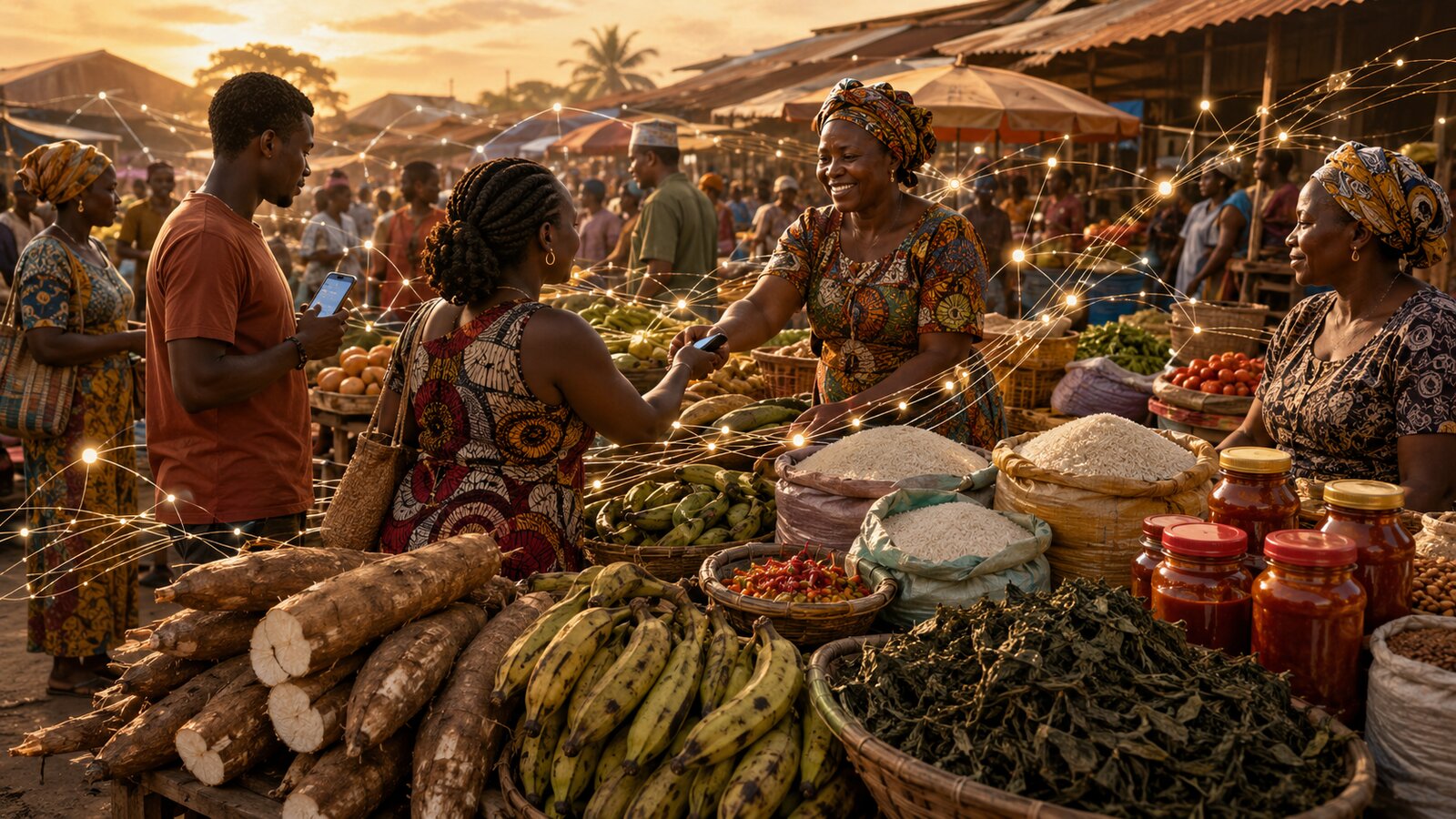
African Food Commerce Has a Visibility Problem — Here’s How Data Will Change It
Disponible en français : Le commerce alimentaire africain a un problème de visibilité — voici comment les données vont le changer
A cocoa farmer in Mbalmayo watches his beans pick up humidity in a storage shed that runs too warm. 280 kilometres away, a Douala roaster has just paid a middleman 1,850 FCFA per kilo for cocoa beans — more than the global market price that week. Neither knows the other exists. Neither will ever know they each lost money that month.
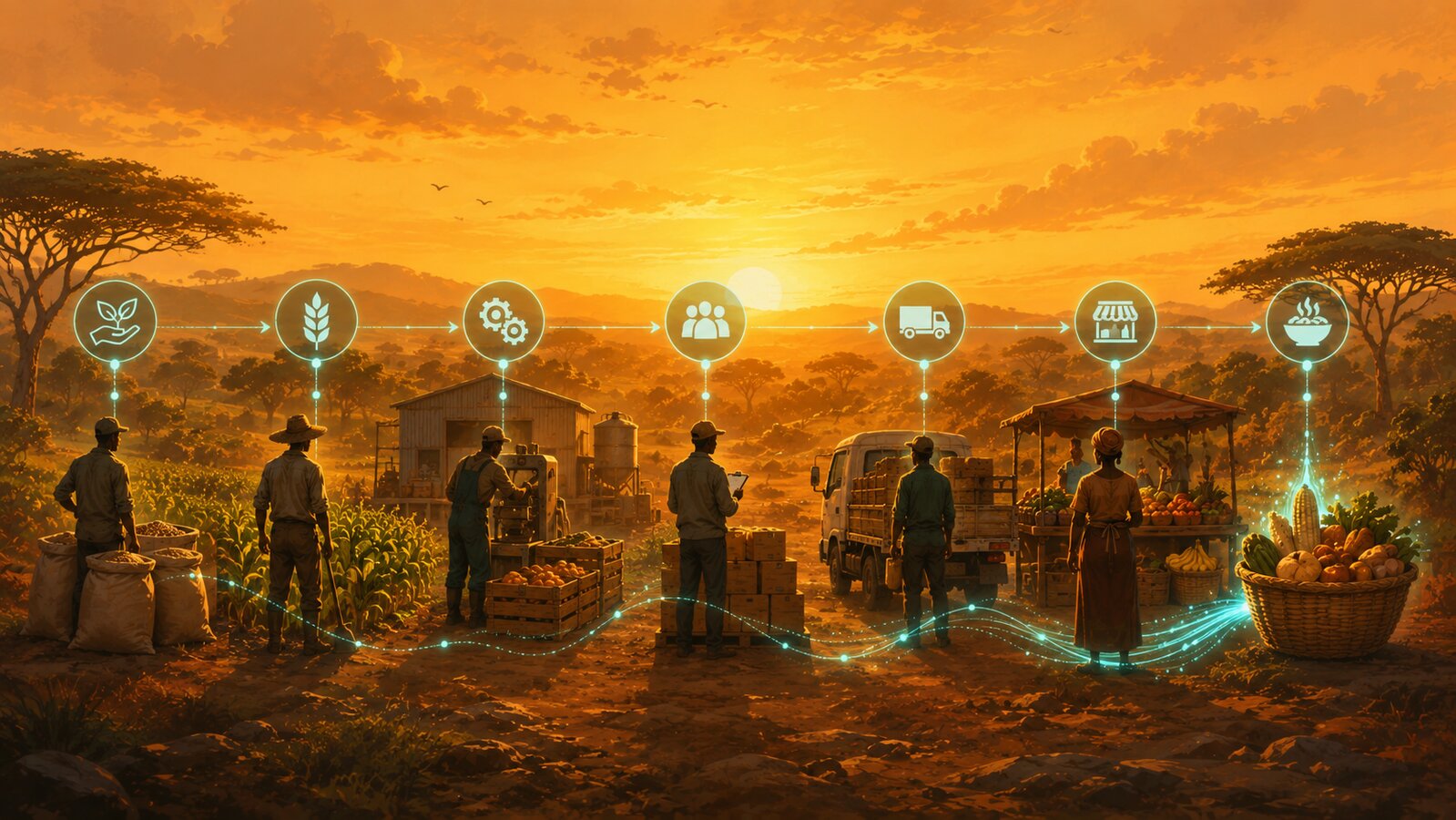
This isn’t an exception. It is the default operating mode of food commerce in Africa. The supply exists. The demand exists. Promotions exist. Stocks to move before expiry exist. But between those who sell and those who buy, there is no information infrastructure — only silos, phone calls, WhatsApp groups, shop-front displays, and a lot of luck.
This article isn’t about discounts. It is about what happens when food commerce data becomes visible — and why that transition, which looks technical, is in fact the deepest transformation African food markets will live through over the coming decade.
The problem: a market operating blind
When inefficiency in the African food chain comes up, the reflex is to point at production — not enough yield, not enough irrigation, not enough inputs. True, but secondary.
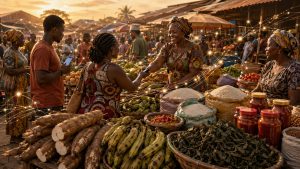
The real problem is that information circulates poorly. When a baker in Yaoundé wants to buy flour, he has three or four suppliers in mind, his WhatsApp contacts, and that’s it. He has no way to know that a processor in Bafoussam has just cut the price by 8% on a stock they need to move. When a neighbourhood shop receives an end-of-line palm oil batch at –25%, they post it on their shop front — and only the customers walking past find out. For everyone else, the promotion does not exist.
This opacity has a cost. Several costs, in fact:
- For the consumer — she pays more than she should, because she doesn’t know that two streets away the same product is on offer. In a context where the food basket already represents 40–60% of Cameroonian household budgets, that surcharge is not marginal.
- For the seller — he sells slower than he could. His promotions reach a limited circle, his stock turns over slowly, his cashflow tightens. When the product has an expiry date, the bill becomes brutal: outright food losses.
- For the chain — producers receive no signal to adjust output. If oil demand drops because consumers have switched to a competing brand running a promotion, nobody in the chain sees it. Everyone keeps producing the same volumes, hoping they will sell.
This isn’t a problem of willingness. Sellers and buyers want to find each other. It is a problem of infrastructure — there is no market-wide common place where information concentrates.
What has changed: digitalisation makes data capturable
For a long time, this visibility problem had no obvious solution. To make a promotion visible to 10,000 potential buyers, a seller would have needed mass advertising — radio, TV, billboards. Out of reach for 99% of sellers.
Three things have changed in less than a decade:
- The smartphone has become majority. In Cameroon, more than 60% of the urban adult population accesses the internet via mobile, and penetration keeps growing. Consumers no longer read printed flyers — they check their phones.
- Sellers have already started digitalising their communication. WhatsApp, Facebook, Instagram, statuses, community groups — all of it exists and runs. But these channels are fragmented: they reach subscribers, not the market.
- Discovery behaviours have shifted. Before buying a motorbike, people check classifieds. Before picking a restaurant, they read reviews. Before booking a hotel, they compare prices. Before food shopping, people are starting to do the same — and it is precisely this habit that creates the need for a centralised infrastructure.
The consequence is simple: data exists today where it didn’t ten years ago. Every digital shop transaction leaves a trace, every published promotion leaves a footprint, every consumer comparison produces a signal. The only work left is to collect this data in a common place and make it useful.
What data changes — concretely, for each actor
When promotion visibility becomes shared infrastructure — and not an individual workaround — four transformations kick in.
1. The consumer moves from hunting to comparing
Today, finding a good food promotion in Cameroon is a job: you go out, you look, you ask, you compare in your head. Tomorrow, it is a gesture — a few seconds on the phone. The consumer stops taking the posted price as given and starts choosing between known alternatives. Power shifts.
2. The seller moves from word-of-mouth to structured reach
A promotion published on a structured platform no longer reaches only the trader’s WhatsApp subscribers — it becomes discoverable by every buyer searching for the product. The ROI of a promotion changes nature: it is no longer a margin sacrifice to retain customers, it is a visibility investment to acquire them.
3. The chain finally receives signals
When promotions, sales and searches feed the same data stream, the chain starts seeing things it couldn’t see before: which products urban consumers are searching for, which regions show abnormally high prices, which stocks move fast, which products stagnate. These signals travel back to processors, to distributors, and ultimately to producers. The chain aligns with demand instead of guessing at it.
4. The market starts speaking a common language
And perhaps the deepest transformation, the least visible: when information circulates, the market becomes comparable. Price gaps between regions become visible — so negotiable. Arbitrage becomes possible. Abusive margins shrink. Local producers become competitive against imports because their better price is visible.
Jangolo’s bet: laying the first stone
This is the transformation Jangolo wants to accompany. Not just with a market price catalogue — already available — not just with a marketplace — already active — but also with a third pillar that was missing until now: a visibility infrastructure dedicated to food promotions.
Jangolo Promotions was born from a simple observation: if you want the African food market to become fluid, you have to start by making discoverable the offers already there. The good prices that exist. The end-of-line stocks sleeping in shops. Goods that need to move before short expiry dates. The promotional operations agroindustries already run — but which reach only an insider circle.
The ambition isn’t to invent the food promotion — it has existed forever. The ambition is to turn the food promotion into a market signal: a message captured, indexed, compared, and made accessible to thousands of buyers instead of a few dozen.
What this opens — over 2-3 years
Looking further, the stakes are not only about saving Cameroonian families a few hundred FCFA per month — even if that already matters. The stakes are what happens when enough promotions, transactions and shopping behaviours are captured to start mapping the market.
- Real-time market intelligence — which products are rising, which are stagnating, where, when, at what price.
- Demand forecasting — for processors and cooperatives, knowing what will sell in 30, 60, 90 days changes how you plan.
- Food loss reduction — when a short-expiry stock becomes instantly visible to 5,000 potential buyers, it moves. What doesn’t move ends up as outright loss, and Cameroon today loses a significant share of its agricultural production before it ever reaches the table.
- Local product valorisation — Penja pepper, Western maize flour, Southern red palm oil, Northern bissap — products urban consumers often buy by default at prices that don’t reflect their real value. A visibility infrastructure finally gives these products a voice.
A starting point, not an end point
Today, Jangolo Promotions is a starting point. The platform hosts its first offers — a few products, a few sellers, in a few cities. The modesty is deliberate: the goal is to lay the infrastructure, prove it works, and let it grow with those who want to take part in this transformation.
If you are a consumer, what we propose today is simple: build the habit of checking offers before you shop. A few seconds that can make the difference on a basket of groceries.
If you are a seller, processor, shop or cooperative, what we propose is this: publish your first offers and see what visibility changes for your business. It is free, it is fast, and it is building something larger than yourselves — a new standard for African food commerce.
The African food market will soon stop being short of offers. It will be short of visibility. And visibility is being built right now.
Read the rest of the series
- Article 2 — Why food promotions have become essential in Cameroon
- Article 3 — How to find the best food promotions near you
- Article 5 — Why promotions are a strategic tool for agroindustries
(links will be added as articles publish over the next 3 weeks)
Share this content:
Partager :

En savoir plus sur
Subscribe to get the latest posts sent to your email.