Agricultural chemicals: health dangers for producers and consumers (and how to protect yourself)
Across Africa, farming has become heavily “chemicalised”: pesticides, herbicides and fungicides, but also forcing agents (to trigger flowering) and artificial ripening products. Used at the right time and with the right precautions, some of these products have their uses. Mishandled, they poison — first those who use them, then those who eat.
The figures are staggering: by some estimates, up to 385 million people suffer acute pesticide poisoning worldwide each year, and Africa pays a heavy price. Nearly 60% of pesticides sold on the continent are reportedly classified as hazardous by the WHO, and in several surveys more than 80% of smallholders use no protective equipment at all. This article takes stock — it serves as the reference our crop guides point to whenever a risky product is involved.
💡 This article is informational and does not replace the advice of a health professional or an agricultural adviser. In case of poisoning, go to a health centre without delay.
Which products, for which uses?
Pesticides (insecticides, herbicides, fungicides)
These are the most widespread: they protect crops from pests, diseases and weeds. The problem is not the principle but the practice: highly hazardous products (WHO classes I and II), molecules banned elsewhere but still sold locally, counterfeits with no reliable label, overdosing “just to be sure”. In Cameroon, studies among market gardeners (Centre and West regions) have found residues in vegetables and health problems linked to a lack of protection.
Forcing agents (flower induction)
To group pineapple flowering, many growers in the Moungo use calcium carbide (which releases acetylene) or ethephon, sometimes mixed with caustic potash (potassium hydroxide). Effective, but corrosive and toxic when handled without protection.
Artificial ripening and preservation
To sell faster, some ripen fruit with calcium carbide or “preserve” it with formalin (formaldehyde). In Cameroon, formalin has been reported not only on fruit and plantain but also on fish and meat. These practices target short-term cash and sacrifice the consumer’s health.
Fertilisers
Less acutely toxic, they still require careful handling and controlled dosing: too much nitrogen, for example, degrades product quality and pollutes soils and water.
The impact on producers’ health
The producer is on the front line: they are the one mixing, spraying and breathing it in.
In the short term, exposure causes headaches, dizziness, nausea, vomiting, eye and skin irritation and, in severe cases, convulsions or respiratory distress. Caustic potash burns skin and eyes — up to blindness.
In the long term, repeated and poorly protected exposure is associated with neurological, respiratory, hormonal and reproductive damage; for certain molecules and contaminants (such as the arsenic present in industrial-grade carbide), an increased cancer risk is documented.
Why is it so serious in Africa? Because usage conditions compound the dangers: no protective equipment (more than 80% of producers in some surveys), products stored at home, next to food and within children’s reach, reused containers for water or oil, and labels poorly understood for lack of information. In Cameroon, work by CIRAD has quantified the “hidden costs” of this use: lost working days, care and hospitalisations.
The impact on consumers’ health
What the field receives, the plate gets back.
Pesticide residues. When the pre-harvest interval (the minimum time between the last treatment and picking) is not respected, the product reaches the market loaded with residues. Cameroon has experienced this in exports: cocoa rejections for residues in 2012 and 2016, then a suspension of horticultural exports to the European Union in 2022 for the same reasons.
Calcium carbide. Used to ripen fruit, it releases acetylene often contaminated with arsenic and phosphine. Banned in many countries, it is associated in consumers with neurological and respiratory disorders and an increased cancer risk.
Formalin. Formaldehyde is classified as a carcinogen. In Cameroon, the Ministry of Trade has issued alerts and announced market checks with detection kits; Gabon has even introduced tests on fruit and vegetables imported from Cameroon. A “beautiful” fruit is therefore not always a healthy one.
How to reduce the risks: good practices
For the producer
- Choose approved products, never counterfeits or banned molecules; read and follow the label.
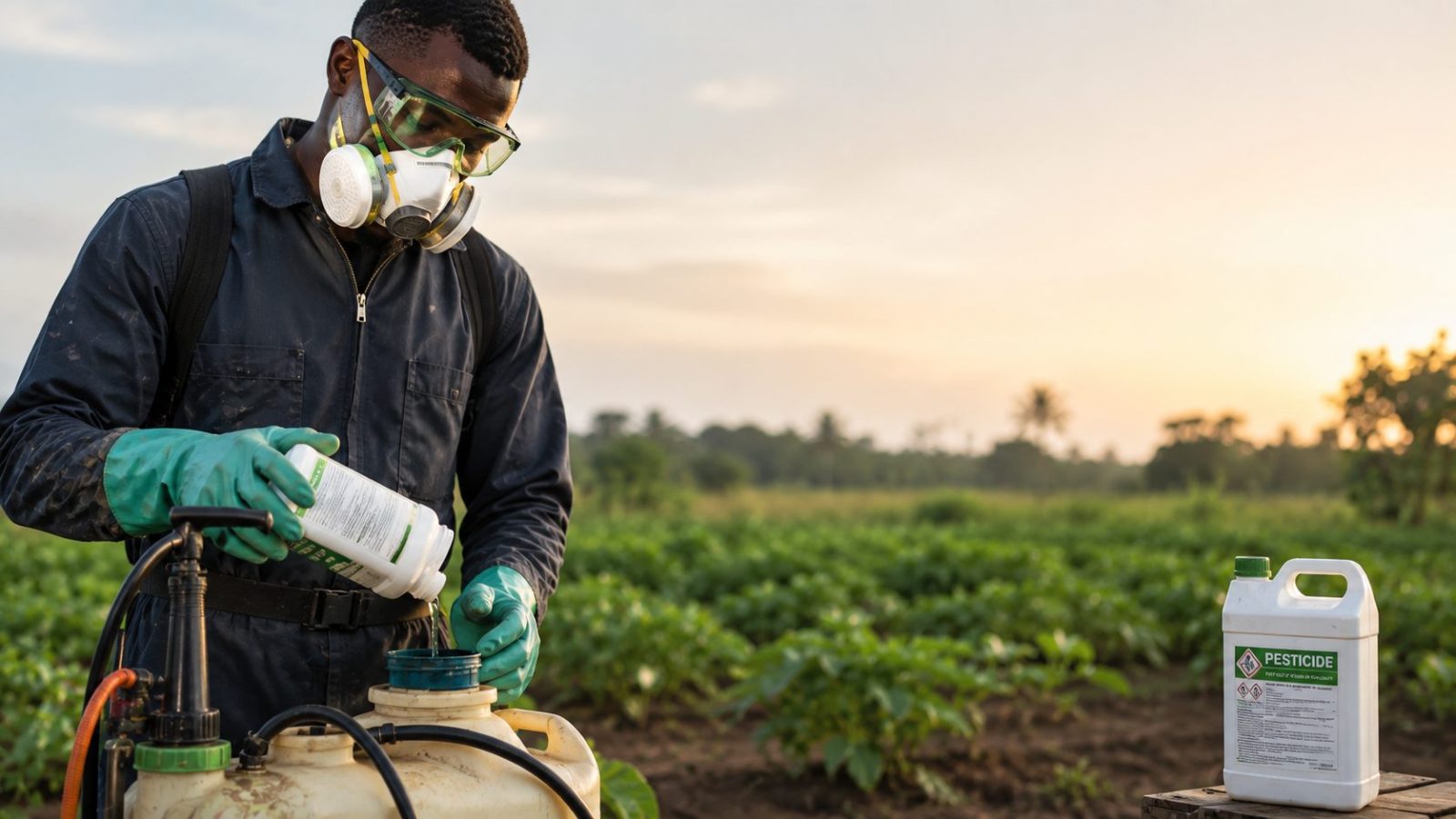
- Wear protective equipment: resistant gloves, goggles or a face shield, a suitable mask, boots and covering clothing.
- Respect the dose and the pre-harvest interval: “more” does not mean “better”, and it is this interval that protects the consumer.
- Manage containers: rinse three times, never reuse them for water or food, store products locked away, far from food and children.
- Prefer alternatives: integrated pest management (traps, natural predators, rotations), biopesticides, and gentler methods such as ethylene-enriched activated-carbon flower induction (TIFBio) for pineapple, or natural ripening.
For the consumer
- Wash and, where possible, peel fruit and vegetables; discard the soaking water.
- Be wary of “perfect” ripeness: uniform colour but hard or green flesh inside, a chemical smell, or fruit that spoils abnormally fast can betray artificial ripening.
- Buy through traceable channels, from identified producers and traders.
Frequently asked questions
Is calcium carbide dangerous for ripening fruit?
Yes. It releases a gas often contaminated with arsenic and phosphine, banned in food in many countries. Regular consumption of fruit ripened this way is associated with neurological and respiratory disorders and an increased cancer risk.
Is formalin on food serious?
Yes. Formalin (formaldehyde) is a carcinogen. Using it to “preserve” or ripen food is banned and dangerous; in Cameroon it is the subject of official alerts and market checks.
What protective equipment is needed to spray pesticides?
At a minimum: chemical-resistant gloves, goggles or a face shield, a suitable respirator, boots and covering clothing. Spray with your back to the wind and wash thoroughly afterwards.
What is the pre-harvest interval?
It is the minimum time to respect between the last treatment and harvest, shown on the product label. Respecting it gives the product time to break down and limits residues on the plate.
Are there alternatives to chemical products?
Yes: integrated pest management, biopesticides, organic fertilisation, crop rotation, and “natural” forcing and ripening methods. They require more know-how, which is why support from an adviser helps.
In conclusion
Agricultural chemicals are not inevitable, but they demand knowledge and precautions. Well used and well supervised, they have a place; mishandled, they cost lives — those of producers and consumers alike. The good news is that most tragedies are avoidable with simple steps and a little support.
Need help? Get support from an agricultural advisory firm, join the conversation on the farmers’ forum and create your Jangolo account to sell healthy, traceable products.
Sources and further reading
- Greenpeace Africa — Food or Poison? The cost of Highly Hazardous Pesticides
- The global distribution of acute unintentional pesticide poisoning, BMC Public Health
- CIRAD — Characterisation of the hidden costs of pesticide use in Cameroon
- Cameroon Ministry of Trade — alerts on the use of formalin in food
- University of Liège — ethylene-enriched activated-carbon flower induction in pineapple (TIFBio)
Partager :

Discover more from Jangolo Blog
Subscribe to get the latest posts sent to your email.