Profitable pig farming in Cameroon: costs, margins and African swine fever
Pig farming is one of Cameroon’s most dynamic livestock sectors. In 2024 it was worth around 231 billion FCFA for a volume of roughly 77,000 tonnes of meat, with projected annual growth of about 9%. Well managed, it is highly profitable — but it demands rigour, particularly in the face of African swine fever. This guide details the real costs, breeds, housing, target margins and the risks to control.
Why start a pig farm?
Pigs combine rare advantages: fast growth (slaughter weight of 90–100 kg reached in 6 to 8 months), high prolificacy — an improved sow delivers on average two litters a year, of about 8 to 9 piglets each — and steady demand. Consumption is rising, driven by the Centre, Littoral and West basins, and national output rose from 46,000 t in 2022 to nearly 49,400 t in 2023. The government has even created pig agropoles (Kribi, Bafoussam, Yaoundé) to structure the sector.
Which breeds to choose?
The dominant breed is the Large White, found in around 7 of 10 improved farms. The best-performing setups combine breeds:
- To produce piglets: Landrace sows crossed with a Large White boar (good prolificacy and maternal qualities).
- For fattening: Large White × Duroc crosses, prized for fast growth and meat quality.
Starting with improved breeding stock (rather than the slow-growing local pig) is one of the first levers of profitability.
How much does it cost? The key items
- Weaned piglet (≈ 3 months): around 15,000 FCFA each.
- Feed: the top item, often 60 to 70% of total cost. Commercial feed runs around 2,500 FCFA/kg; formulating your own ration (maize, bran, oil cakes, cassava, mineral supplements) sharply cuts the bill — provided you respect the needs of each stage (starter, grower, finisher).
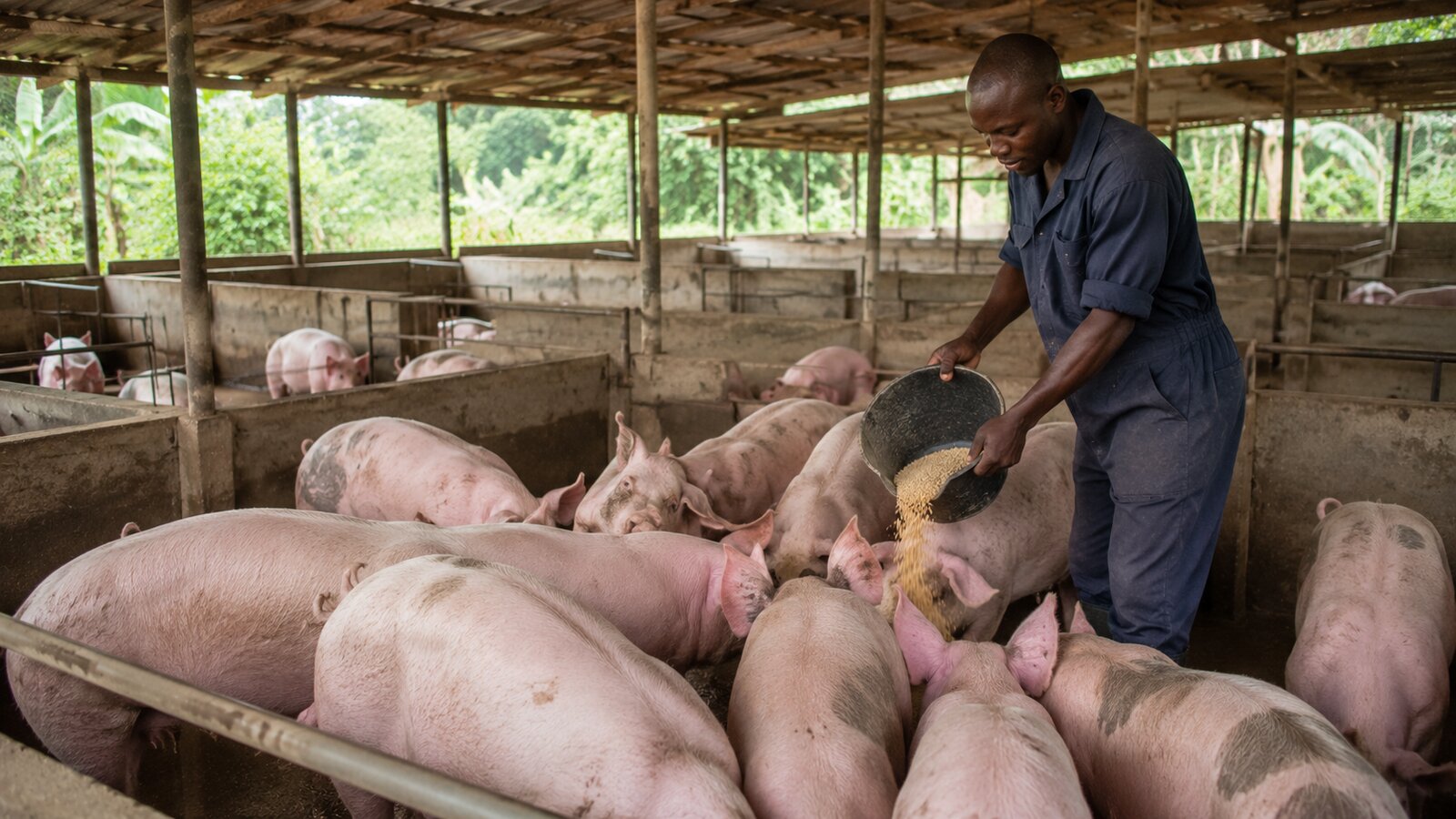
- Housing (piggery): a sloped concrete floor with a drainage channel, separate pens (farrowing, post-weaning, fattening), good ventilation, a water point and a quarantine area. Size it to the herd.
- Health and prophylaxis: internal/external deworming, vaccinations, iron supplementation for piglets, and above all biosecurity (see below).
Housing: designing a functional piggery
A well-designed piggery saves time, limits disease and improves growth. The fundamentals: a floor that is easy to wash and disinfect, clear separation of pens by physiological stage, permanent access to clean water, protection from sun and rain, and a controlled entry zone (footbath, change of boots) to isolate the farm from the outside.
What price does pork sell for?
Fattened pigs are sold either live weight, at around 650 to 700 FCFA/kg, or as slaughtered meat, around 1,000 FCFA/kg. Selling weaned piglets (≈ 15,000 FCFA each) provides a regular complementary income, often more liquid than fattening. Prices rise ahead of the year-end festive season.
What profitability to expect
Techno-economic studies put the gross profit at around 14,000 FCFA per fattened pig. A well-run farrow-to-finish operation can target an annual gross profit of around 2 million FCFA, and more as the herd grows. The real margin levers:
- Control feed cost through self-formulation and bulk buying of raw materials.
- Limit mortality through prophylaxis and biosecurity.
- Monetise both outputs: piglets AND finished pigs.
- Sell at the right time and price, tracking the market rather than taking whatever dealers offer.
African swine fever (ASF): the number-one risk
You cannot discuss pigs in Cameroon without African swine fever, now endemic. In June 2021, an outbreak in the West region — one of the country’s largest basins — led to the culling of 90,000 pigs in three months, about 22.5% of the regional herd (estimated at 400,000 head). The virus is highly resistant, with no reliable treatment or commercial vaccine: prevention is the only weapon.
The biosecurity measures that save a farm:
- Strictly control entries (visitors, vehicles, new animals) and place every new arrival in quarantine.
- Disinfect constantly (footbath, equipment, dedicated boots).
- Avoid feeding kitchen waste containing pork (a classic contamination route).
- Immediately report any suspicious mortality to veterinary services.
Other risk factors
- Feed cost, which determines most of the margin — an item to manage to the kilo.
- Local regulation: some municipalities restrict or ban pig farming in dense urban areas (odours, effluent).
- Start-up financing: plan the cash to cover 6 to 8 months of feed before the first sale.
Frequently asked questions
How much does a piglet cost in Cameroon?
Around 15,000 FCFA for a weaned 3-month piglet from improved breeds.
How long does fattening take?
About 6 to 8 months to reach a slaughter weight of 90 to 100 kg, depending on the breed and, above all, feed quality.
Is pig farming profitable?
Yes: a gross profit of around 14,000 FCFA per fattened pig is realistic when feed, health and biosecurity are well managed.
What price does pork sell for?
Around 650 to 700 FCFA/kg live weight, and about 1,000 FCFA/kg as slaughtered meat.
What is African swine fever?
A highly contagious, often fatal pig disease (harmless to humans) with no available vaccine. It is endemic in Cameroon: only strict biosecurity protects a farm.
Financing and selling: structuring your project
A pig project needs start-up capital (piggery, breeding stock, several months of feed). To find the right sources, read our guide on financing your agricultural project in Cameroon. And to sell your pigs at the best price — markets, direct sales to restaurants and institutions, cooperatives, or online — see every channel for selling your farm produce.
Going further
Ready to start? Post your pig offer on Jangolo and reach buyers directly. See also our complementary short-cycle livestock guide: catfish farming.
Partager :

Discover more from Jangolo Blog
Subscribe to get the latest posts sent to your email.