Cameroon’s Cocoa Value Chain: An Underexploited Treasure
Available in French: La chaîne de valeur du cacao au Cameroun : un trésor sous-exploité
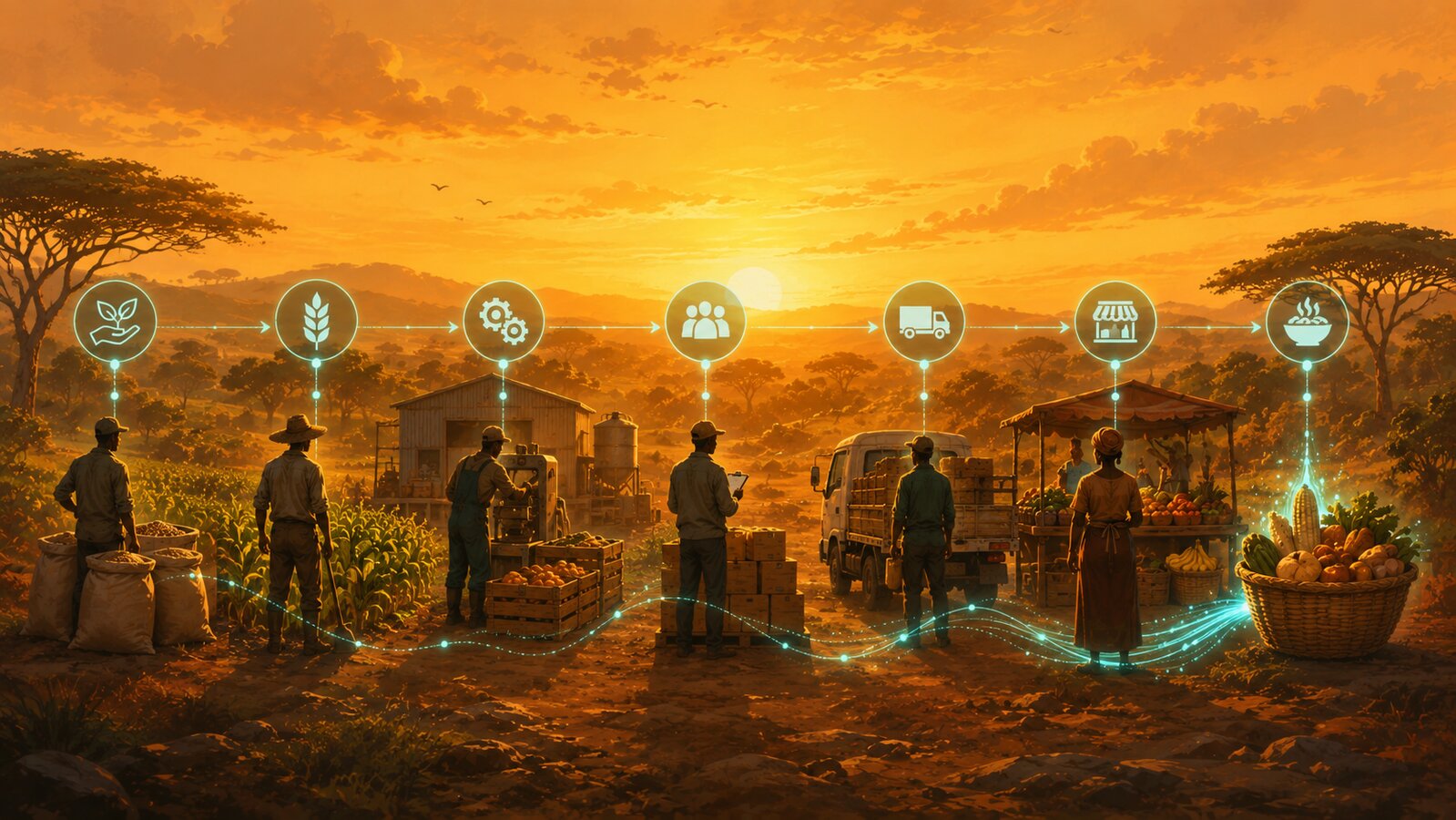
Cocoa holds a strategic economic position across West and Central Africa, and Cameroon ranks among the top five producers in the world. Yet despite this leading position, the Cameroonian cocoa value chain remains largely underexploited — most beans leave the country in raw form, with high-margin processing happening elsewhere. This article looks at the state of the sector, its structural challenges, and how an agribusiness infrastructure like Jangolo can accelerate its transformation.
1. An Underexploited Treasure: Cameroon’s Position
Cameroon produces an average of 280,000 to 300,000 metric tons of cocoa per year, ranking 5th globally behind Côte d’Ivoire, Ghana, Ecuador, and Indonesia. The sector directly supports more than 600,000 households, primarily in the Centre, South, Southwest, and Littoral regions.
Commercially, cocoa remains one of the country’s top sources of agricultural foreign currency. The Netherlands and Belgium — hubs of European industrial chocolate — are among the main buyers. The sector is regulated by the National Cocoa and Coffee Office (ONCC), which oversees quality, marketing, and statistics.
Here’s the paradox: despite these volumes, over 80% of Cameroonian production is exported as raw beans. Local processing (into paste, butter, powder, finished chocolate) remains marginal. The result: the value-added captured in the chain happens elsewhere — in Europe, Asia, North America. The country produces the raw material; others harvest the margins.
2. Structural Challenges of the Sector
Several obstacles prevent the Cameroonian cocoa value chain from reaching its potential:
- Aging plantations — a large share of the national cocoa orchard is over 30 years old, with declining yields. Replanting moves slowly due to limited financing and shortage of improved planting material.
- Disease and climate pressure — swollen shoot virus, black pod (Phytophthora) and increasingly irregular rainfall weigh on yields and quality.
- Price information asymmetry — farmers often sell without visibility into international prices or what’s being paid in neighboring producing zones. (This is exactly the focus of our series on market prices as missing infrastructure.)
- Low local processing — less than 20% of Cameroonian production is processed locally. The country’s chocolate-cocoa industry remains embryonic despite some notable initiatives.
- Cross-border smuggling — every year, significant volumes of cocoa leave the country illegally toward neighboring Nigeria, drawn by higher purchase prices at the border.
- Limited credit access — smallholder farmers struggle to finance inputs, nursery materials, or plantation rotation.
- Evolving European regulation — the EU’s new Deforestation Regulation (EUDR) imposes strict traceability of cocoa origin, requiring information systems that the largely informal sector lacks.
3. Levers to Transform the Value Chain
Several levers can unlock the underexploited potential of Cameroon’s cocoa sector:
- Renew the cocoa orchard — accelerate replacement of aging plantations with improved varieties that are more productive and disease-resilient.
- Develop local processing — support the emergence of processing units (cocoa paste, butter, powder, chocolate) to capture more value-added before export. The annual Festicacao-Festicoffee event is a positive signal in this direction.
- Strengthen traceability — anticipate EUDR requirements with digital traceability systems by plot, by cooperative, by lot. Without traceability, Cameroonian cocoa risks losing access to premium European markets.
- Improve access to reference prices — give producers real-time access to international prices and prices paid in different production zones, breaking the information asymmetry.
- Structure cooperatives — better-organized cooperatives negotiate fairer prices, access financing more easily, and meet export quality requirements. (See how digital platforms fix broken agricultural trading.)
- Promote origin cocoa — leverage the specific quality of Cameroonian cocoa (fine cocoa, certain terroirs) to access premium segments rather than being subject to standard cocoa world prices.
4. The Role of Consumers and Local Processors
Transforming the sector doesn’t depend solely on producers and public authorities. Cameroonian and African consumers also have a role to play:
- Choose “made in Cameroon” chocolate when available — every purchase supports local processors trying to capture value-added domestically.
- Support local chocolatiers and pastry chefs who source from Cameroonian processed cocoa rather than imported industrial chocolate (which paradoxically often comes from West African cocoa, processed in Europe).
- Advocate for public policies that favor local processing, orchard renewal, and access to financing.
For Cameroonian food processors, this is also the moment to engage: the raw material is available, the digital ecosystem is taking shape, and African regional demand for industrial chocolate is growing rapidly.
5. How Jangolo Can Help Structure the Cocoa Sector
The Jangolo ecosystem offers several tools specifically useful for the cocoa sector:
Jangolo Market Prices — Transparency on Purchase Prices
Real-time access to bean purchase prices in different Cameroonian production zones (Centre, South, Southwest, Littoral), contributed by the community itself. Producers can compare before selling, rather than accepting whatever the first buyer offers. For more detail: how real market prices help farmers, traders and buyers make better decisions.
Jangolo Trades — Connecting Cooperatives, Processors and Exporters
B2B marketplace where cooperatives publish their cocoa offers (volumes, quality, certifications) and buyers (local processors, exporters, regional traders) publish their demands. This reduces dependence on informal intermediaries and lets better-organized cooperatives reach buyers beyond their immediate network. See this article on Jangolo Trades.
Jangolo Experts — Agronomic Expertise on the Orchard
Connection with cocoa-specialist agronomists for advice on variety choice, fighting swollen shoot and Phytophthora, nursery management, and orchard rejuvenation. Particularly valuable in a sector where technical know-how directly determines yields.
Traceability and EUDR-Ready Structuring
By making cocoa-sector actors discoverable and their transactions documentable, Jangolo helps structure a sector that is largely informal today — a prerequisite for anticipating EUDR traceability requirements and keeping access to European markets. (See how Jangolo connects the entire agribusiness value chain.)
Conclusion: A Historic Window of Opportunity
Cameroon’s cocoa sector is at a turning point. International cocoa prices reached historic highs in 2024, reflecting structural production difficulties in West Africa. Global demand for chocolate continues to grow, especially in Asia. EUDR traceability requirements will soon reward structured sectors and penalize informal ones. Cameroon has the production potential, the emerging processing ecosystem, and the market window.
What’s missing is coordination — between producers and cooperatives, between cooperatives and processors, between processors and buyers. A digital infrastructure like Jangolo can accelerate that coordination by making market information transparent and connecting actors beyond their personal networks.
Cameroon’s cocoa treasure is real. The work now is to fully unlock its value.
Read more
- From Informal Trading to Structured Agribusiness Markets
- Why Market Prices Are the Missing Infrastructure of African Agriculture
- Understanding the Agribusiness Value Chain
- Why Every Agripreneur Should Be on Jangolo
Cocoa producer, cooperative, processor, or exporter in Cameroon? Join Jangolo and connect to the African agribusiness ecosystem →
Share this content:
Partager :

Discover more from Jangolo Blog
Subscribe to get the latest posts sent to your email.