Banana export in Cameroon: industry, players and opportunities
The export banana — the Cavendish dessert banana — is one of Cameroon’s leading agricultural export products. Every week, refrigerated ships leave the ports of Douala and Tiko for Europe, loaded with cartons calibrated to the gram. In 2025, the country shipped 225,345 tonnes of bananas, up 7% year-on-year according to the Banana Association of Cameroon (ASSOBACAM), confirming its position as Africa’s second-largest supplier behind Côte d’Ivoire.
This highly industrialised sector follows very different rules from the plantain grown for local consumption. Yet it feeds an entire local economy — jobs, subcontracting, processing — and offers real opportunities to producers and SMEs who know where to position themselves. Here is a complete overview: figures, players, market requirements, opportunities and challenges.
Cameroon’s banana industry in figures (2025)
Four operators account for most of the country’s exports. Here are the 2025 volumes published by ASSOBACAM:
| Operator | 2025 exports (tonnes) | Year-on-year change |
|---|---|---|
| PHP (Plantations du Haut Penja) | 151,713 | −1% |
| CDC (Cameroon Development Corporation) | 42,286 | +33.6% |
| CDBM (Compagnie des Bananes de Mondoni) | 23,814 | +69.5% |
| Boh Plantations | 7,532 | −35.8% |
| Cameroon total | 225,345 | +7% |
Figures are published every month and watched as a genuine barometer of the sector. The 2025 momentum is driven mainly by the recovery of the state-owned CDC and the rise of CDBM, which offset the slight decline of market leader PHP and the gradual retreat of Boh Plantations.
Who exports Cameroonian bananas?
PHP (Plantations du Haut Penja), a subsidiary of Compagnie Fruitière, remains by far the leader, with more than two-thirds of national volumes. It is also one of the country’s largest private employers (around 6,000 to 7,000 direct employees), with plantations concentrated around Njombé-Penja and Loum, in the Moungo division.
The CDC, a 100% state-owned agro-industrial company based in the South-West, saw its volumes jump by more than 33% in 2025 after several difficult years. CDBM, Compagnie Fruitière’s second Cameroonian subsidiary, posted the strongest growth in the sector. Boh Plantations, on the other hand, has become the smallest player. All are grouped within ASSOBACAM.
The dessert banana: a tightly standardised product
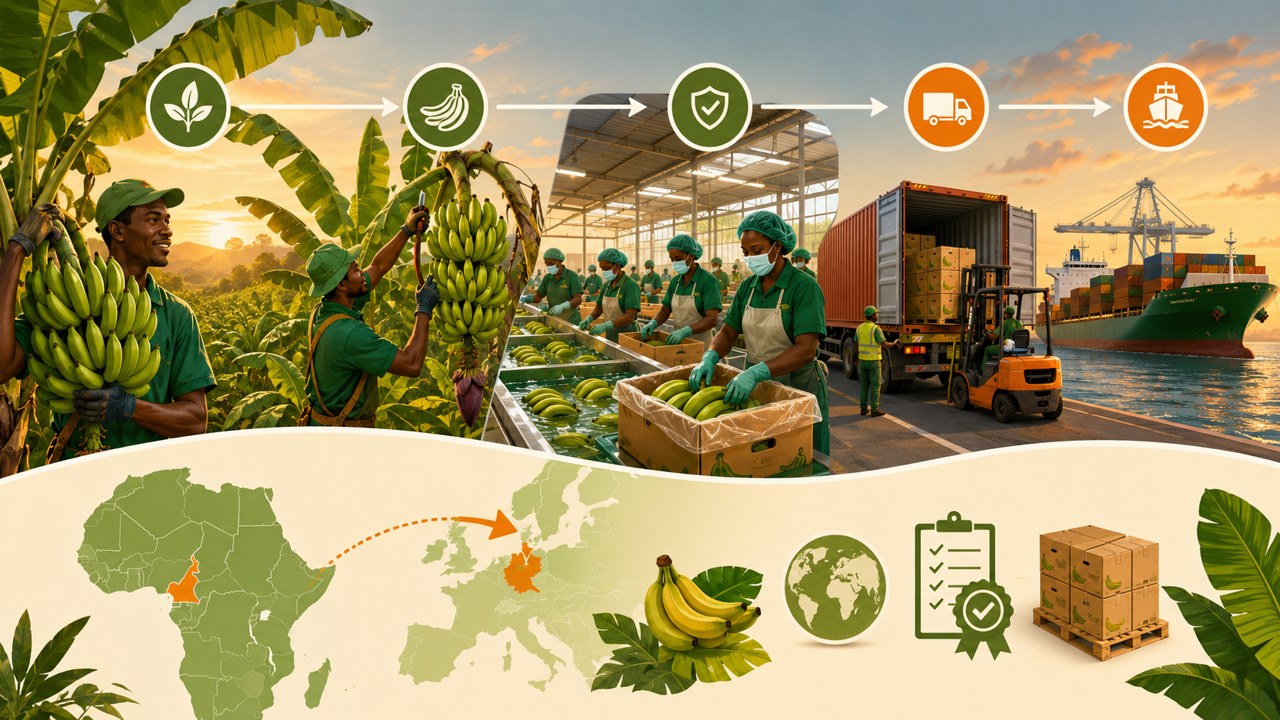
Unlike plantain destined for local markets, the export banana is a standardised product that tolerates almost no deviation. To reach European supermarkets, growers must meet:
- Flawless calibre and quality: Cavendish variety, finger length typically 20–25 cm, precise age at cutting, zero visual defects, packing in cartons of around 18.5 kg.
- A finely tuned cold chain: washing, packing, weekly refrigerated vessels (reefers), then ripening rooms on arrival in Europe.
- Certifications: GlobalG.A.P., Rainforest Alliance, Fairtrade and sometimes organic, depending on the buyer — essential to list fruit with major retailers.
- Full traceability, from the plot to the carton.
These requirements explain why direct exporting is out of reach for an isolated grower — but they open other doors, as we will see below. To understand international standards and outlets, read our guide on distributing and selling agricultural products, from the local market to export.
The European market: a major outlet, fierce competition
The European Union is by far the leading market for African bananas. But competition is intense. Each year, Africa exports around 600,000 tonnes to the EU — a drop in the ocean compared with the roughly 5 million tonnes shipped by Latin America. The “dollar banana” (Ecuador, Colombia, Costa Rica…) accounted for around 75% of the European market, while the African producers’ share slipped from about 10% to 9% over the past decade.
Cameroon therefore fights on two fronts: against the Latin American giants, and against its African neighbours, Côte d’Ivoire and Ghana. In this context, competitiveness comes down to yields, consistent quality and control of logistics costs.
What concrete opportunities exist for local players?
The export banana is often dismissed as a business reserved for multinationals. That’s wrong: the sector supports an entire ecosystem, and several niches are within reach of Cameroonian SMEs and producers.
1. Jobs and subcontracting
The plantations rank among the country’s biggest private employers: agronomy, quality control, logistics, maintenance. Around them gravitates a host of service providers — transport, packaging manufacturing, input supply, irrigation maintenance.
2. Adding value to “grade-outs”
Bananas that are perfectly good but outside export calibre never reach Europe. They supply local markets and, above all, processing: chips, flour, purées. In Cameroon, several banana and plantain processing units have been launched, and the Profalcam platform is targeting hundreds of thousands of tonnes of local flour by 2027. This is a genuinely high-value-added business within reach of SMEs — the same logic that drives Cameroon’s broader value-chain ambitions, as we explored in our analysis of Cameroon’s cocoa value chain.
3. Regional plantain and the diaspora
Less standardised than the dessert banana, plantain is exported to the sub-region and the diaspora. It is a more accessible route to start with — and a strong complement to the dessert-banana business.
4. Selling and structuring your production
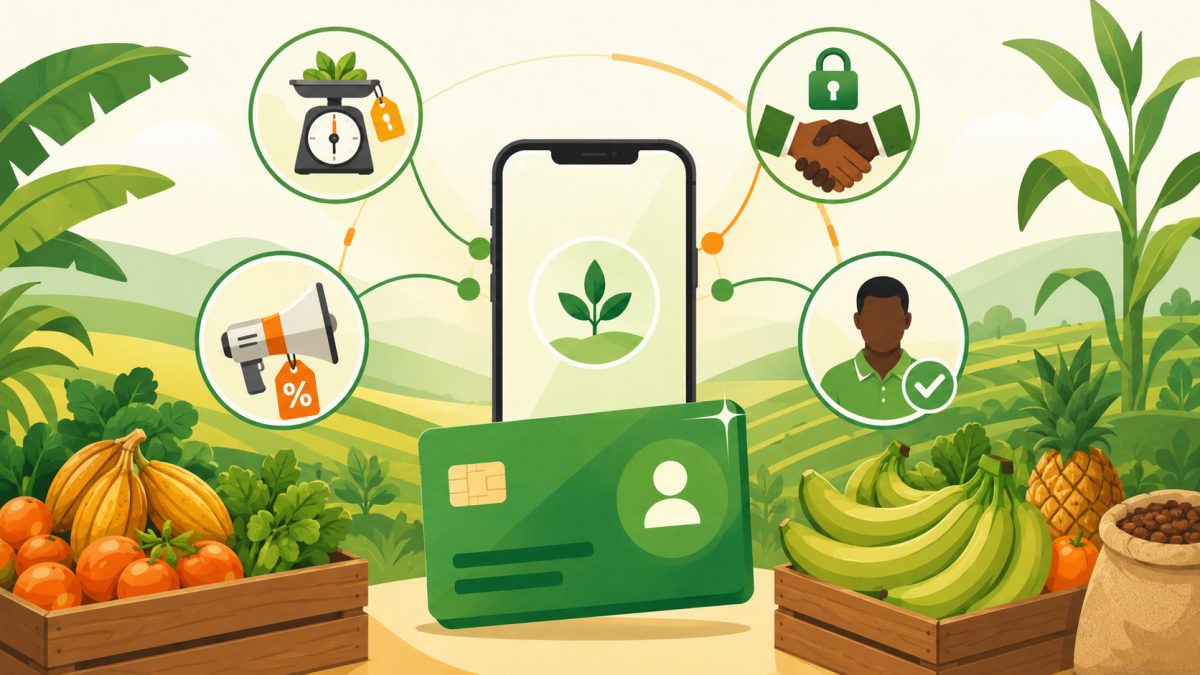
Whether you grow local sweet bananas, plantain or processed products, the challenge is to find buyers and sell at the right price. That is exactly where Jangolo’s tools come in: discover every channel for selling your farm produce, and why understanding market data instead of selling blind is a game changer, as explained in how data is changing African food commerce.
The sector’s challenges
Cameroonian bananas advance against several headwinds:
- High logistics and energy costs, which weigh on competitiveness against Latin America.
- Pest pressure, in particular black sigatoka, which requires rigorous fungicide treatment programmes — hence the importance of careful management of agricultural inputs for the health of workers and nearby residents.
- Climate variability and the need to invest in irrigation and varietal research (disease-resistant Cavendish hybrids are under development).
- Growing social and environmental expectations: duty of vigilance, working conditions, and water and input use are now closely scrutinised by markets and civil society, pushing the sector toward more sustainable practices.
Frequently asked questions
How many bananas does Cameroon export?
In 2025, Cameroon exported 225,345 tonnes of dessert bananas, up 7% year-on-year (source: ASSOBACAM). PHP alone accounts for more than 150,000 tonnes.
What is the difference between an export banana and plantain?
The dessert banana (Cavendish) is eaten raw and shipped to Europe; plantain, richer in starch, is cooked and mainly supplies local and sub-regional markets.
Can a small producer export dessert bananas?
Directly, it is very difficult (standards, certifications, logistics, volumes). The realistic routes are: joining the subcontracting chain of the large operators, targeting regional plantain, or processing grade-outs into chips and flour.
Which certifications are needed to sell in Europe?
The most requested are GlobalG.A.P. (good agricultural practices), Rainforest Alliance and Fairtrade, sometimes complemented by organic certification, depending on the retail chains targeted.
Where can I track the sector’s figures?
The monthly export volumes published by ASSOBACAM, relayed by the Cameroonian business press — and regularly summarised on the Jangolo blog.
Going further
Plantain and local sweet-banana producers: sell directly on Jangolo, track market prices and also add value to your grade-outs with processors. To move from the local market to export, also read our guide on distributing and selling agricultural products.
Partager :

Discover more from Jangolo Blog
Subscribe to get the latest posts sent to your email.